How Much Does AI Development Cost in 2026? A Complete Guide

How much does AI development cost?” Simple question with a very complicated answer. Because AI is not one thing. You could be building a basic AI-powered chatbot for your website. Or a full-scale system using advanced AI and ML solutions. Both come under “AI development.” But the cost is completely different. You search for AI development costs, hoping for a clear number. But instead, you see ranges that make no sense. Some say a few thousand. Some go into lakhs or even crores.
The truth is, there’s no fixed AI development cost. Because AI app development cost, AI software development cost, and even custom software development cost depend on what you’re actually building. With the rise of AI, skilled talent is expensive, that’s why AI engineers’ high consulting rates have become a big part of the overall cost. Whether you’re exploring generative AI, working with a custom software developer, or building something specific like healthcare software development, understanding the cost is less about the number and more about what goes behind it.
Every CFO asking “what’s our AI budget for this year?” gets a different answer from every vendor they talk to. One quotes $30,000. Another quotes $300,000. A third wants a discovery call before giving any number at all. The AI development cost question is genuinely complex and that complexity costs companies more than the projects themselves when they go in underprepared. According to McKinsey’s 2025 State of AI report, 88% of organizations now use AI in at least one business function. Yet only 6% qualify as high performers generating measurable EBIT impact. The gap between those two groups almost always traces back to poor cost planning, not poor technology.
What Does AI Development Actually Cost in 2026?
The honest answer is that AI development cost can be anywhere between $5,000 and $1M+. That’s a huge range but it’s not random. It’s not vendors throwing numbers around, it’s just reality because what you’re building changes everything.
A simple chatbot and a full AI platform are not even in the same conversation. Here’s what it actually looks like when you break it down:
| Project Type | Estimated Cost | Timeline |
| Basic AI MVP / rule-based chatbot | $5,000 – $50,000 | 4–8 weeks |
| Mid-tier ML model / NLP solution | $50,000 – $200,000 | 2–5 months |
| Enterprise AI platform | $200,000 – $500,000+ | 6–12 months |
| Custom LLM / deep learning system | $500,000 – $1M+ | 12+ months |
At a glance, this looks straightforward. But this is just the build cost. The part most people see. What usually gets missed is actually everything around it: Data preparation, Cloud infrastructure, System integrations even maintenance. And these are not small add-ons. They quietly stack up and push the total cost much higher than what you initially planned. That’s where most teams get surprised. Not by AI itself. But by everything it needs to actually work.
The Five Cost Drivers That Actually Move the Needle
Understanding AI software development cost means knowing what actually inflates or controls your budget. Five factors consistently account for the largest share of AI development cost.
Model Complexity: The Biggest Single Cost Driver

Model complexity is the single biggest lever. It accounts for 30–40% of total project cost. A standard NLP sentiment analysis tool costs far less than a deep learning system requiring multi-layer neural networks with GPU-based training. Transfer learning, adapting a pre-trained model rather than building from scratch can reduce training costs by 60–70%.
Data quality and preparation surprises most first-time AI buyers. Data work consumes 20–40% of project budgets. Manual labeling for complex tasks like medical image annotation can start at $30,000 alone. When data is clean, structured, and accessible, timelines compress significantly.
Integration, Talent, and Maintenance Costs
Integration depth is where enterprise projects quietly double in cost. Connecting an AI system to existing CRMs, ERPs, or legacy databases rarely goes smoothly. A “simple” integration becomes a weeks-long process when API limitations, data mapping, and edge case handling surface. In many enterprise projects, integration takes longer than model training itself.
Talent rates remain high. AI engineers’ high consulting rates reflect real supply-demand pressure. Independent AI consultants charge $150–$300 per hour. Full-time ML engineers in the US earn $120,000–$165,000 annually. Workers with machine learning skills command a 40% wage premium over comparable software roles, according to 2026 labor data.
Ongoing maintenance catches teams off guard. AI models drift as customer behavior and data patterns shift. Most organizations spend 15–25% of their initial development cost annually on maintenance, retraining, and optimization. Building this into the original budget is not optional. It’s the difference between a functioning system and an expensive pilot that never scales.
AI App Development Cost by Industry
Industry context changes the cost equation significantly. Healthcare software development projects carry compliance burdens that simply do not exist in other sectors. Regulated environments require audit trails, HIPAA-aligned data handling, and human-in-the-loop validation infrastructure. These requirements can add 20–30% to base development costs when not planned from the start.
Here is how AI app development cost typically breaks down by sector:
| Industry | Typical Cost Range | Primary Cost Driver |
| Healthcare AI | $20,000 – $500,000+ | Compliance, data privacy, validation |
| Fintech / Banking | $50,000 – $300,000 | Regulation, fraud logic complexity |
| Retail / E-commerce | $15,000 – $150,000 | Recommendation engines, personalization |
| Manufacturing | $50,000 – $400,000 | Computer vision, predictive maintenance |
| Logistics | $30,000 – $200,000 | Route optimization, demand forecasting |
Healthcare and finance almost always sit at the top of the range due to regulatory overhead. Retail projects with defined scope can deliver strong ROI at moderate cost.
Build In-House, Hire a Custom Software Developer, or Outsource?
This choice shapes AI development cost more than most technical decisions. Each model has a different risk and cost profile. In-house development gives you control and IP ownership. But the true cost of hiring a senior AI engineer: salary, benefits, onboarding, plus tooling runs $150,000–$220,000 annually per specialist. Building even a small AI team requires three to five such hires before meaningful output begins.
Working with a custom software developer or specialist firm offering software development services gets you faster time-to-value. Custom software development cost through a reputable partner typically ranges $50–$200 per hour depending on geography and expertise. Nearshore or offshore software development services can reduce hourly costs by 40–60% while maintaining technical quality when the partner has certified AI practitioners.
Why Hybrid Models Are Growing Fast
Hybrid models combine an internal tech lead or project manager with an external development team. This structure gives businesses control over priorities while benefiting from external AI specialization. It’s the fastest-growing engagement model among mid-market firms in 2026.
Durapid’s AI and ML Solutions team uses exactly this model. Certified practitioners pair with client-side stakeholders to move from scoping to production deployment without the overhead of a full internal hire.
When to Use Pre-Built AI vs. Custom Development
Not every business problem needs a custom-built solution. This distinction can save hundreds of thousands of dollars. Pre-built AI tools: SaaS platforms, API-based models, fine-tuned foundation models suit businesses with standard use cases, limited data, and fast timelines. Costs start as low as $20–$200 per month. These tools cover most chatbot, text classification, and basic analytics needs well.
Custom software development becomes necessary when the problem requires proprietary data, unique business logic, or competitive differentiation. If you’re building something that creates a genuine moat, say, a demand forecasting model trained on five years of proprietary logistics data, that’s where custom software development cost starts to justify itself.
The mistake companies make is defaulting to custom when off-the-shelf works fine. Or defaulting to off-the-shelf when their problem genuinely demands a custom solution.
Hidden Costs Most Budgets Miss
The visible line items: model development, engineering hours, cloud setup represent perhaps 60% of true AI software development cost. The rest surfaces mid-project or post-deployment.
Governance and compliance retrofitting is the most expensive surprise. Organizations in healthcare and finance that discover compliance requirements after development begins face 20–30% budget increases for security controls, audit implementation, and data privacy frameworks.
How Delays and Drift Add Up
Timeline overruns compound fast. A project planned for 8 weeks that stretches to 16 weeks does not simply cost twice as much. Combined delays on labor, infrastructure, and missed opportunities can inflate the final bill by 2–3x.
Model retraining is ongoing. Market behavior changes. Data distributions shift. A production model without a retraining plan degrades quietly. The cost of rebuilding after degradation exceeds the cost of planned maintenance.
Durapid’s Generative AI practice accounts for all these lifecycle costs upfront during project scoping. This prevents the budget surprises that stall 89% of AI projects before they reach production.
Practical Ways to Control AI Development Cost Without Cutting Corners
Cost optimization in AI is about smart sequencing, not cheap shortcuts. Start with an MVP. Validate business value on a narrow use case before scaling. Organizations that follow this approach typically see measurable results within 6–18 months. They also avoid large sunk costs on unvalidated assumptions.
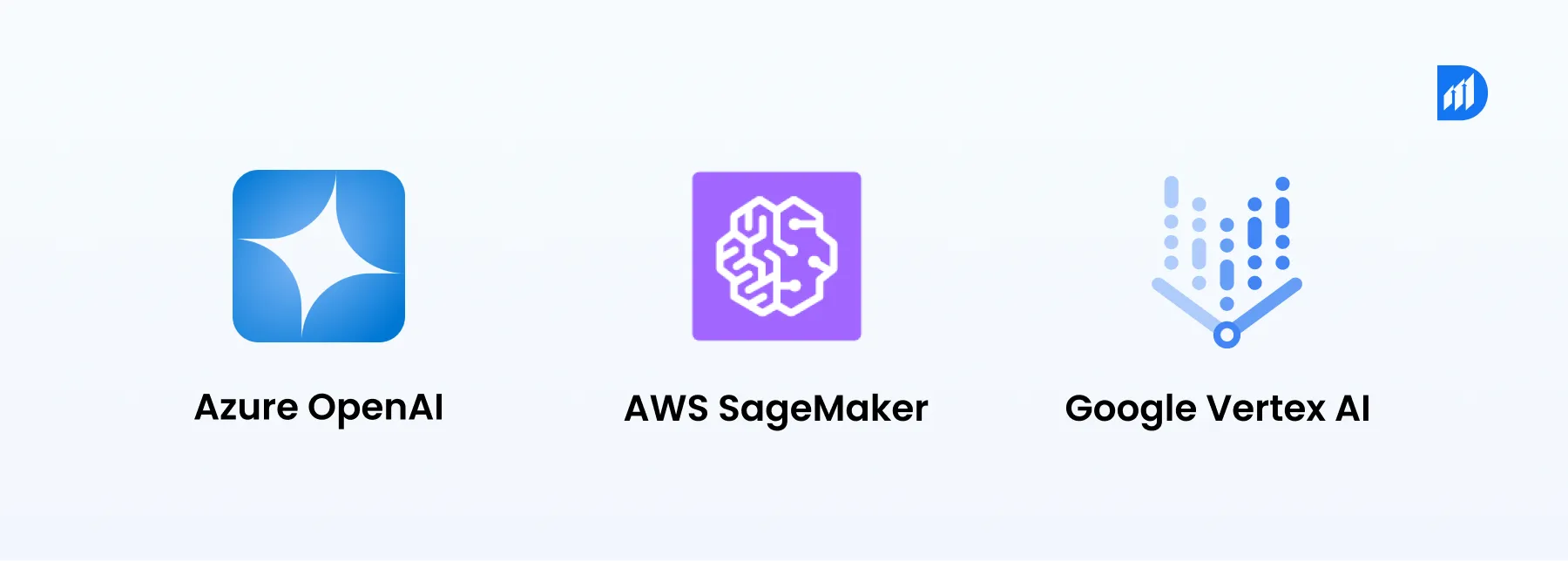
Use transfer learning. Fine-tuning a model like GPT-4 or a Hugging Face transformer for your specific domain costs 60–70% less than training from scratch. Choose cloud-native infrastructure from day one. Azure OpenAI, AWS SageMaker, and Google Vertex AI provide managed ML infrastructure that eliminates most of the DevOps overhead tied to self-hosted solutions.
Define success metrics before writing a line of code. The 11% of organizations that successfully reach production all share one trait. They budget for reality, define clear KPIs, and tie every development decision back to measurable business outcomes.
FAQs: AI Development Cost in 2026
What is the average AI development cost for a mid-sized business?
Most serious AI builds put the AI development cost somewhere between $50,000 and $400,000, with a big chunk going into the people building it. Starting small with a focused pilot helps you spend smart before going all in.
Why are AI engineers’ high consulting rates so common in 2026?
Good AI talent is still rare, and demand is only going up. That’s why experienced engineers charge $150–$300/hour because businesses are willing to pay for speed and expertise.
How much does healthcare software development cost with AI included?
AI in healthcare can start around $20,000 and go well beyond $500,000. Compliance, data privacy, and validation make it far more complex than regular builds.
Is custom software development cheaper than hiring an internal AI team?
In most cases, yes. Hiring full-time AI talent is expensive, while working with a custom software development partner gets things built faster without long-term overhead.
What percentage of the budget should go toward AI maintenance?
Roughly 15–25% every year. AI isn’t “build once and done”, it needs updates, retraining, and constant tuning to stay useful.
Durapid Technologies works with teams across finance, healthcare, retail, and logistics to keep AI development cost under control while building systems that actually go live, not just stay in pilot mode. Their software development services span everything from AI-powered chatbots to Generative AI in Healthcare and full-scale AI and ML solutions, always focused on building what works in the real world.
Recent Blog

How Much Does AI Development Cost in 2026? A Complete Guide
March 23, 2026