Healthcare Data Mining: Key Examples, Proven Techniques & Business Benefits
A patient brings chest pain symptoms to the hospital emergency room. The clinical decision support system processes 15 years of medical records and matches patient symptoms against 2 million similar cases. It shows a 78 percent probability of acute coronary syndrome. The system recommends immediate intervention which detects a medical condition before an actual medical emergency occurs. This isn’t science fiction. The current healthcare data mining system functions as a life-saving operation which protects patients right now.
Healthcare organizations generate 2,314 exabytes of data annually. Yet only 3% of this data gets examined for useful insights according to a 2024 RBC Capital Markets report. The U.S. healthcare system loses approximately $342 billion annually because it fails to transform collected data into useful applications. Healthcare data mining transforms unprocessed clinical and operational information into effective solutions which serve as operational links between two worlds. The discovered patterns from this research work lead to better patient outcomes which result in reduced medical costs and faster progress in scientific research.
What Is Data Mining, and Why Is It Important in Healthcare?
The medical field uses data mining to analyze extensive datasets because it provides vital insights which hospitals need to operate efficiently. Healthcare data mining uses statistical analysis methods along with machine learning algorithms and pattern recognition techniques to analyze extensive medical databases. The process identifies hidden relationships between symptoms, treatments, and outcomes that human analysis would miss. Data mining enables researchers to find novel patterns which they analyze through previously unknown data to gain fresh clinical insights that traditional reporting methods cannot provide.
The Journal of Medical Internet Research published a 2023 study which demonstrated that hospitals using predictive data mining models achieved 41% reduction in hospital-acquired infections. The study found that these hospitals decreased their readmission rates by 28% when they were compared to hospitals which used manual analysis methods. The 500-bed hospital will save $4.2 million each year because it will experience 340 fewer incidents which harm patients.
The importance extends beyond individual facilities. Moreover, public health agencies use data mining to track disease outbreaks 2-3 weeks earlier than traditional surveillance methods. Furthermore, pharmaceutical companies accelerate drug discovery by mining clinical trial data to identify patient subgroups most likely to respond to treatments.
What Is Data in Data Mining, and How Is Healthcare Data Collected and Prepared?
Data in data mining includes structured data and semi-structured data and unstructured data. Organizations collect this information from their source systems to prepare for analysis. The data mining process in healthcare uses six main data types. These include clinical records and laboratory results and medical imaging. They also include claims and billing data and patient-reported outcomes and operational data.
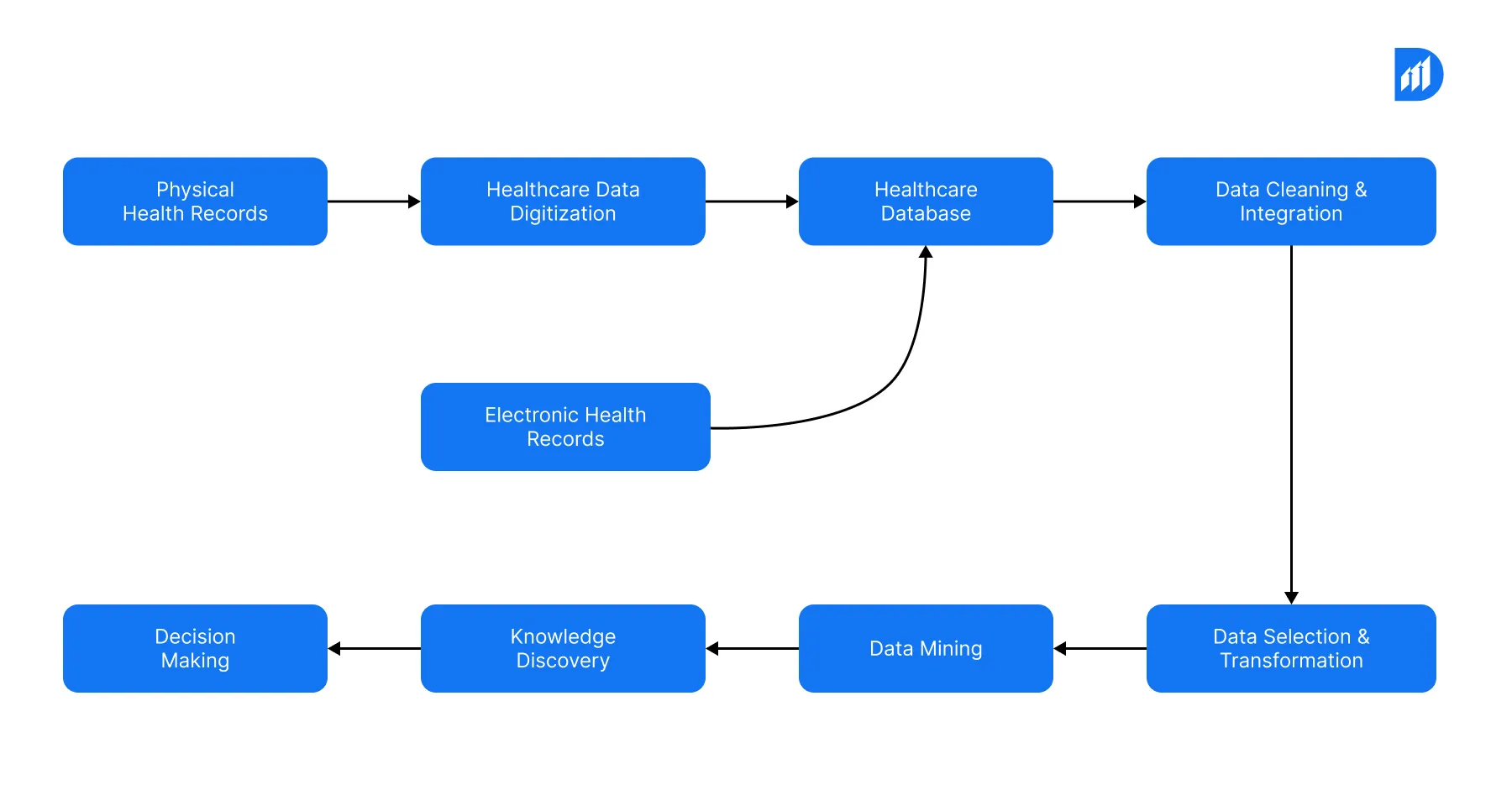
The data collection procedure starts with extracting information from multiple systems. A hospital network typically operates between 12 and 15 software applications which lack direct integration capabilities. Consequently, data engineers construct extract, transform, load pipelines through the implementation of Apache NiFi and Azure Data Factory. They utilize these tools to extract data from their systems every 15 minutes. This ensures accurate operations between actual time and near real-time performance.
Data Preparation and Quality Management
Healthcare data mining projects dedicate 60 to 80 percent of their time to data preparation work. The analysis process breaks down medical information because raw medical data includes errors, duplicate records, and missing elements. Thus, the process of standardization involves converting data into standardized formats. This happens through the application of medical coding systems. These include ICD-10 for diagnoses, CPT for procedures, and LOINC for laboratory observations.
Data preparation work in a healthcare system that processes 800,000 patient encounters each year normally detects issues. It corrects between 12 and 18 percent of records that contain quality problems. Meanwhile, the requirement for privacy protection creates extra challenges. This is because healthcare data mining needs to follow HIPAA rules. It also needs to de-identify protected health information before it undergoes analysis.
How Does Data Mining vs. Data Analytics Differ in Healthcare Decision-Making?
Organizations in healthcare believe data mining and data analytics describe the same process. However, these two fields actually have separate functions. The process of data analytics evaluates existing metrics to solve specific inquiries. These inquiries include the question “What was our average length of stay last quarter?” The method uses statistical techniques on past data to create reports which explain what occurred.
In contrast, data mining uncovers hidden patterns in data which it uses to create predictions about upcoming occurrences. Data mining algorithms work to discover unexpected relationships in datasets. Meanwhile, they also create new patient categories and forecast results through their automatic learning process.
The two technical methods create completely different solutions. Data analytics uses Power BI business intelligence tools to develop dashboards through user-defined queries. On the other hand, data mining uses machine learning methods which include random forests and neural networks. These find patterns that exist across multiple data combinations.
The heart failure readmission study needs to examine 340 clinical factors. It combines these with medication combinations and social determinants and genetic information through one data mining study. Therefore, the analytical process delivers performance tracking to meet regulatory standards. Meanwhile, data mining supplies predictive information which enables effective management of patient healthcare.
What Are the Key Applications of Data Mining in Healthcare?
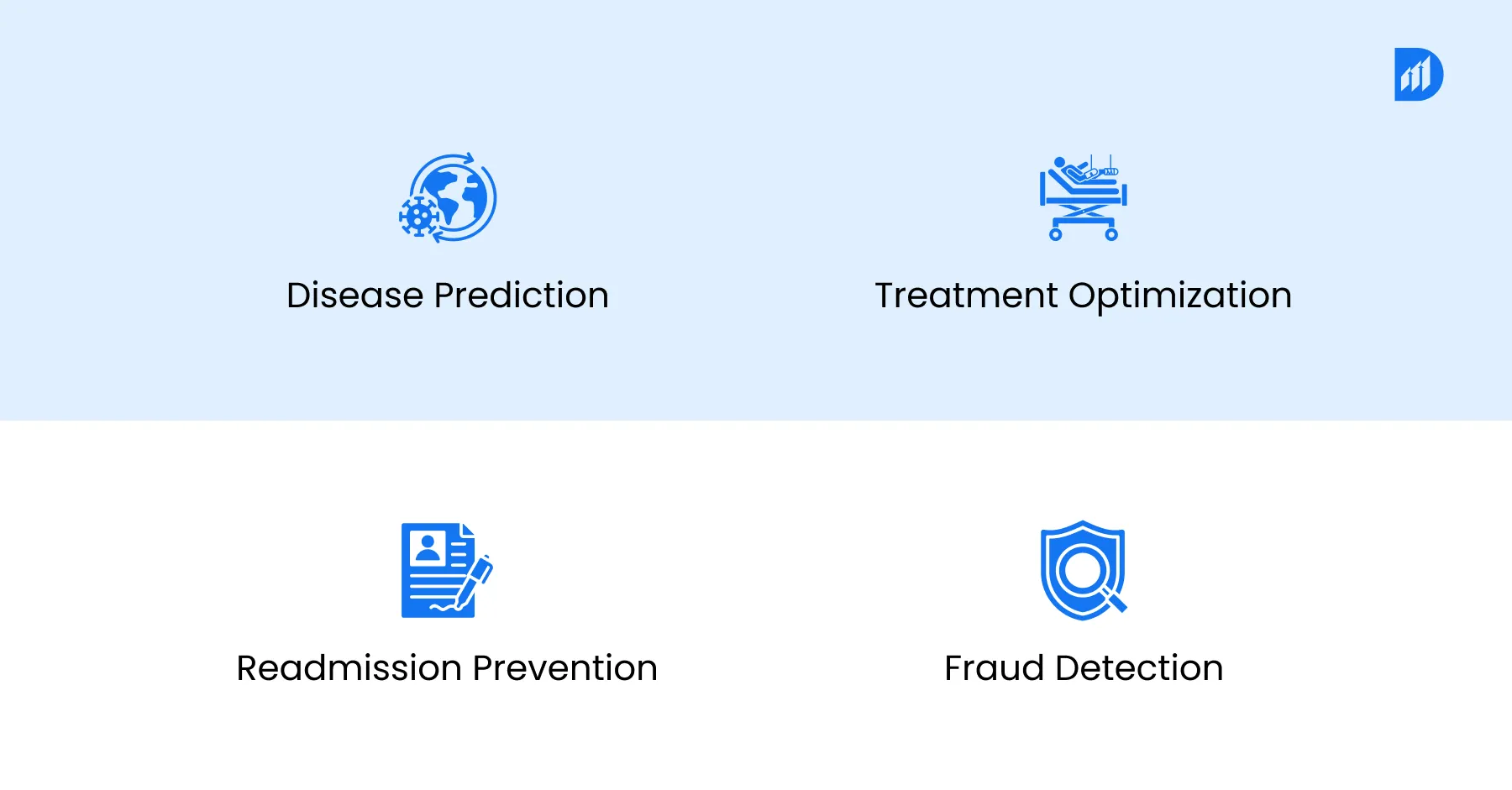
Data mining techniques find their use in clinical care delivery and pharmaceutical development. They also apply to public health initiatives and healthcare operational processes. Disease prediction systems use patient demographics and genetic markers and lifestyle factors. They also use clinical history data to determine individual risk scores.
Disease Prediction and Treatment Optimization
The diabetes prediction model at Kaiser Permanente uses 9.3 million patient records. It identifies high-risk individuals who will develop diabetes within 3 to 5 years. Consequently, this enables preventive interventions that decrease disease occurrence by 31%.
The treatment optimization process needs mining algorithms to identify therapies that will most probably succeed for each patient. Watson for Oncology at Memorial Sloan Kettering analyzes 300 medical journals and 200 textbooks. It also processes 12 million pages of clinical data. It recommends evidence-based treatment options, which it ranks according to confidence scores.
Readmission Prevention and Fraud Detection
The hospital readmission prevention process uses admission data and discharge summaries. It also uses follow-up visit patterns to forecast which patients will return within 30 days. As a result, predictive mining models helped Mount Sinai Health System achieve a 26% reduction in heart failure readmissions.
Fraud detection algorithms study billions of insurance claims to find billing patterns that deviate from normal. Therefore, the Centers for Medicare and Medicaid Services uses claims data to recover $4.3 billion each year from improper payments.
What Role Does a Data Warehouse in Healthcare Play for Data Mining?
The healthcare data warehouse functions as the main data hub which stores all cleansed and standardized and unified data. This comes from the entire organization for analysis purposes. Data warehouses use specific data structures which allow users to search and analyze extensive data collections. These collections span multiple time frames and different patient groups. In comparison, transactional databases focus on documenting single patient visits.
Modern warehouses use columnar storage technologies like Amazon Redshift or Azure Synapse. These compress data and accelerate query performance by 10-50x compared to traditional row-based databases. For instance, a query counting diabetic patients could complete its search of 80 million records within 4 seconds. This is instead of requiring 6 minutes to finish.
The Cleveland Clinic enterprise data warehouse maintains 220 terabytes of clinical and operational data. It gets updated every 15 minutes. The platform supports 340 concurrent mining and analytics workloads daily. This delivers insights that improved sepsis detection by 34%. Additionally, it reduced imaging wait times by 41%.
How Does Data Integration in Healthcare Enable Accurate Data Mining?
The healthcare system uses data integration to create unified datasets from different source systems. Mining algorithms can use these for their analysis. Integration tackles three primary challenges: technical connectivity, semantic consistency, and data quality.
The integration process uses HL7 FHIR and master data management systems. These establish complete patient records through clinical data exchange. Thus, the integration process enables cross-domain mining which produces better insights. It achieves this through the combination of clinical data with claims information and pharmacy records and operational metrics.
Banner Health’s integration platform connects 28 hospitals and consolidates data from 65 source systems. The integrated dataset powers mining models which achieved a 36% reduction in opioid prescribing. Moreover, it discovered 4,200 patients who had undiagnosed chronic kidney disease. It also improved surgical scheduling to achieve an 11% increase in operating room utilization.
How Does Durapid Technologies Help Healthcare Organizations Implement Data Mining?
Durapid Technologies assists healthcare organizations by showing them how to implement data mining solutions. Durapid Technologies provides complete data mining services. Healthcare organizations need these to solve their specific data challenges.
Our 120+ certified cloud consultants design data platforms which can grow to meet future needs on Azure and AWS. They construct healthcare system integration pipelines and warehouse systems. This happens through Apache Spark and Databricks and Azure Machine Learning.
Our organization utilizes custom-built AI and ML solutions. These include natural language processing to extract information from unstructured clinical notes. They also utilize deep learning methods to identify genomic patterns.
We developed two systems which achieved 87 percent accuracy for predicting readmissions. Additionally, our sepsis early warning system detects patient deterioration 18 hours ahead of standard protocols. Therefore, Durapid operates as a Microsoft co-sell partner with more than 150 Microsoft-certified professionals. We deliver enterprise-level healthcare mining solutions with dependable performance.
Frequently Asked Questions
What is healthcare data mining?
Healthcare data mining applies machine learning algorithms to medical datasets for pattern discovery. This enables prediction of patient outcomes and improvement of clinical workflows.
How does data mining improve patient care?
The mining process detects patients who face high risk before they develop complications. It provides tailored treatment recommendations which result in a 25 to 40 percent decrease of adverse events.
What is the difference between data mining and data analytics in healthcare?
Data analytics answers known questions about past performance. Meanwhile, data mining discovers unknown patterns and predicts future events.

Rahul Jain
Recent Blog