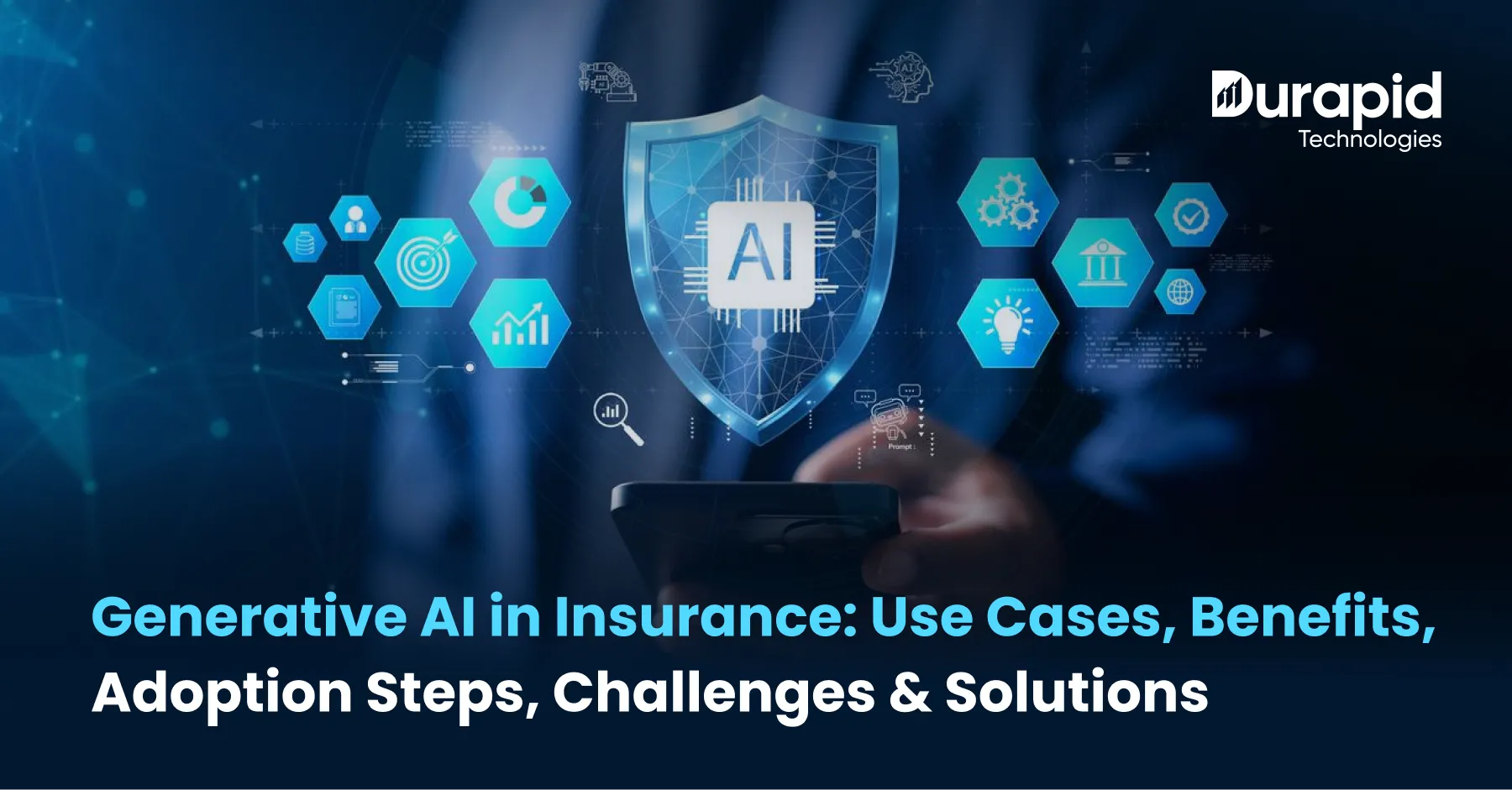
Generative AI in Insurance: Use Cases, Benefits, Adoption Steps, Challenges & Solutions
The introduction of generative AI in insurance has established new operational methods for an industry that generates 6.3 trillion dollars in annual revenue. Insurers maintained their business operations through methods that required extensive documentation until recent times. Claims consumed multiple weeks to complete. Insurers used risk assessment methods that had become obsolete for their underwriting needs. Customers had to wait for several hours before reaching a customer service representative.
McKinsey estimates the global insurance industry will receive an annual economic boost of 1.1 trillion dollars through artificial intelligence. The first insurers to implement changes will secure their positions as market leaders. Those that delay will experience decreasing market presence.
What Is Generative AI in the Insurance Industry?
Generative AI in insurance uses artificial intelligence systems to produce new content, make future predictions, and handle complete insurance operations throughout the value chain. These systems use GPT-4 as their primary large language model while using Azure OpenAI, AWS Bedrock, and Google Vertex AI as their secondary building platforms. The insurance industry utilizes them to analyze unstructured data which includes medical records, accident reports, and customer interactions to create structured information for specific purposes.
How Generative AI Is Transforming Insurance Operations
Insurance companies’ ai implementation 2026 plans are not just about automating procedures. Organizations are transforming their main business operations through complete process redesign. The unified workflow system enables generative AI in insurance to perform document extraction, risk scoring, fraud detection, policy drafting, and agent assistance functions.
Conventional underwriting takes three to seven days as its standard time frame. AI-powered underwriting systems finish the entire process within ten minutes by assessing thousands of risk factors at once. For a mid-sized insurance company handling 50,000 applications annually, this time reduction saves roughly 4.2 million dollars in yearly operational expenses.
Claims processing shows comparable improvements. Additionally, insurers using generative AI report a 40% reduction in processing time and a 25% drop in fraudulent payouts according to Accenture research. The financial impact of claims fraud on the U.S. insurance industry exceeds 80 billion dollars every year.
Key Use Cases of Generative AI in Insurance
The complete insurance value chain receives impact from generative AI technology. Here are the applications insurers currently deploy for the highest operational benefits.
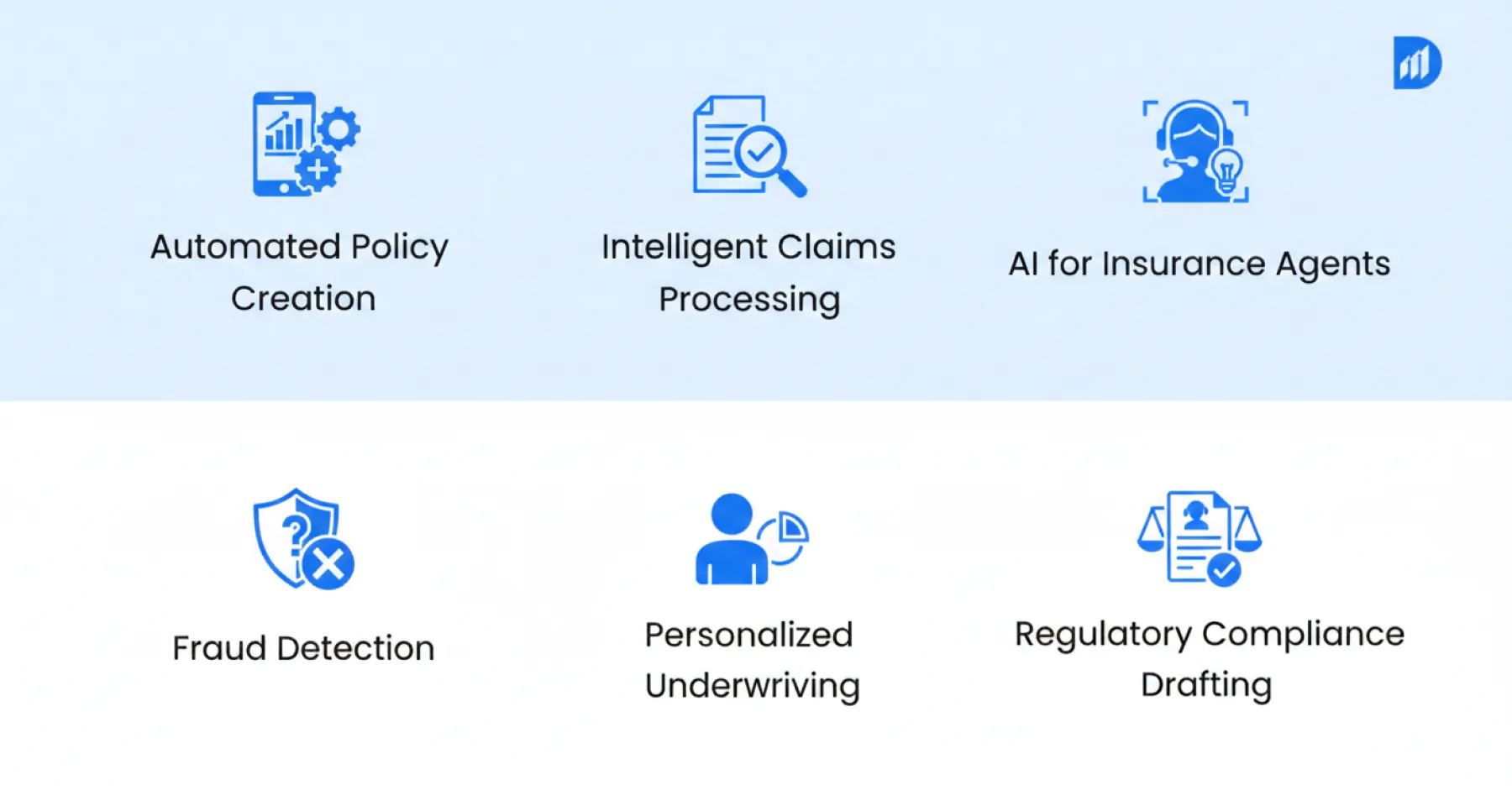
Automated Policy Creation
Imagine generating a fully tailored policy document in seconds. That’s what LLMs are doing by analyzing customer data and instantly structuring it into compliant documentation. The result? Up to 70% reduction in document preparation time. What used to take hours of back-and-forth now happens almost instantly, without compromising accuracy.
Intelligent Claims Processing
AI can now extract and interpret data from photos, medical records, and police reports. For low-complexity claims, it can assess and settle automatically. That means faster resolutions for customers and less manual workload for internal teams. Speed here isn’t just efficiency, it’s better customer experience.
AI for Insurance Agents
This tool functions as a permanent co-pilot for agents. Virtual assistants provide live guidance on policy details, objection-handling techniques, and customer background information during client discussions. The agent receives real enhancement through this. Confidence increases. Conversions follow.
Fraud Detection
Generative models trained on historical fraud data identify suspicious claims with around 89% accuracy. Traditional rule-based systems achieve closer to 60% accuracy across the entire industry. The difference isn’t just technical, it directly impacts loss ratios and operational trust.
Personalized Underwriting
Instead of standard risk groups, AI uses telematics data, health metrics, and behavioral patterns to create personalized risk profiles. Pricing becomes more accurate. Moreover, risk evaluations adapt in real time. Customers feel understood rather than generalized.
Regulatory Compliance Drafting
AI has the capability to create compliance documents, audit records, and regulatory filings that match specific jurisdictional requirements. This reduces manual drafting effort while maintaining legal consistency. In regulated environments, that reliability matters.
Each use case delivers three advantages that benefit the entire insurance value chain: operational cost reductions, faster process execution, and better customer experiences.
Benefits of Generative AI for Insurance Companies
Insurance companies see three main benefits from AI investments: faster operations, more precise results, and reduced expenses. Here is how the numbers break down.
| Metric | Traditional Process | With Generative AI | Improvement |
| Underwriting Time | 3–7 days | Under 10 minutes | 99% faster |
| Claims Processing Time | 14–21 days | 2–5 days | 70% reduction |
| Fraud Detection Accuracy | 60% | 89% | +48% gain |
| Customer Query Resolution | 8–12 minutes | Under 90 seconds | 85% faster |
| Policy Drafting Time | 4 hours | Under 5 minutes | 98% faster |
Beyond speed, generative AI in insurance also drives insurance business intelligence improvements. Insurers gain real-time dashboards, predictive loss ratios, and dynamic pricing models that update daily rather than quarterly.
AI in health insurance brings substantial advantages as well. Carriers processing prior authorizations with generative AI reduce administrative costs by $11 per transaction, which accumulates to millions in annual savings for major health insurance providers.
Step-by-Step Adoption Process of Generative AI in Insurance
The process of implementing generative AI in insurance requires multiple deployment stages to establish complete organizational readiness. Below are the key steps insurers must complete after developing their technical capabilities through proper organizational alignment.
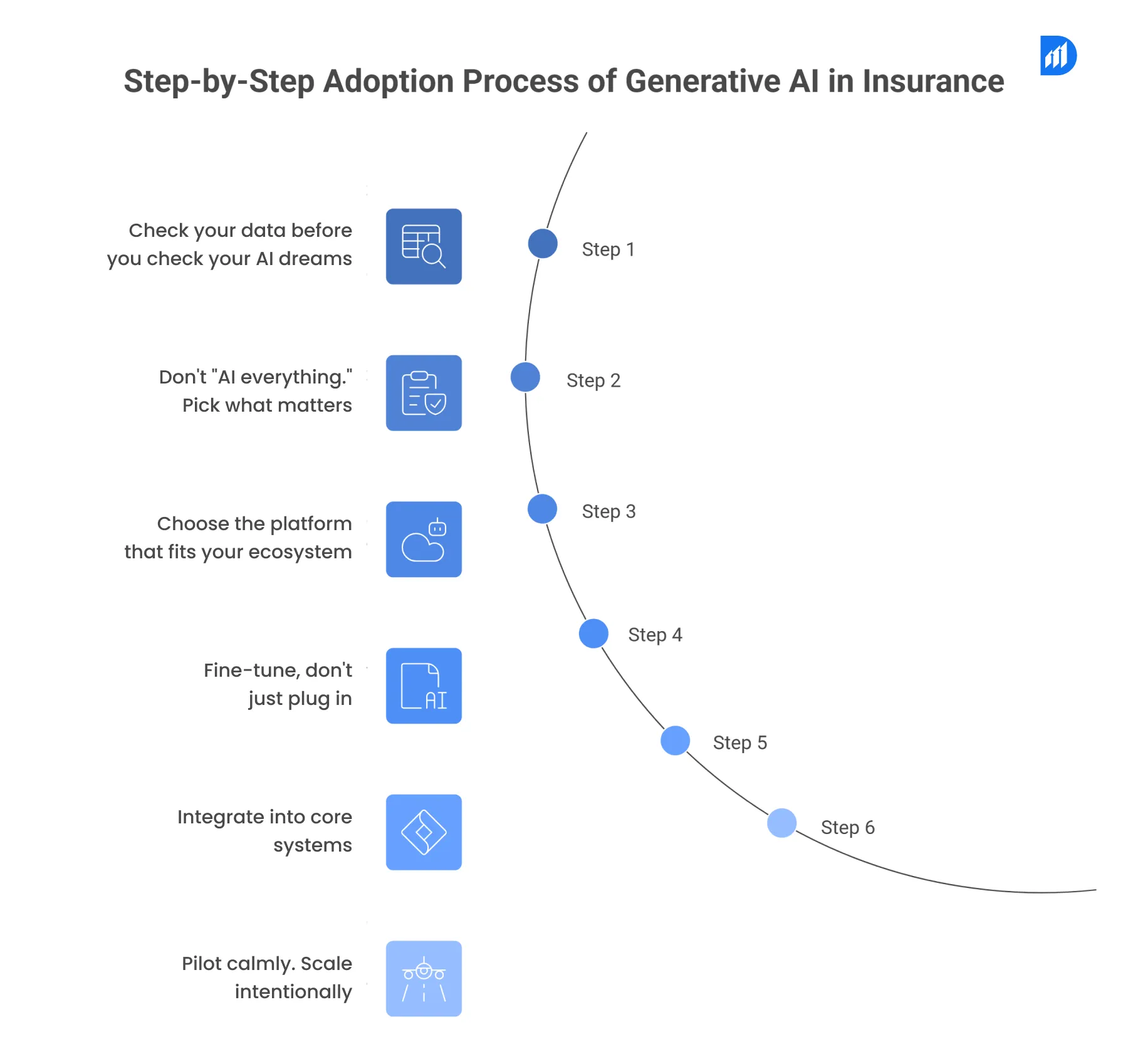
Step 1 – Check your data before you check your AI dreams
You need to assess your existing resources which include policy databases and claims records and customer data. The performance of Generative AI depends on its access to clean and labeled and structured data. The model will show you disorganized results because your data has been distributed across multiple locations and lacks consistent formatting. Your organization has established a strong position through its current use of lakehouse solutions that utilize Databricks and Snowflake tools. The system needs proper foundational work before you proceed with building advanced systems. Effective AI operations require organizations to implement structured work processes.
Step 2 – Don’t “AI everything.” Pick what matters
You should select two or three high-impact use cases that track their outcomes through claims automation and underwriting support and AI copilots for agents. The purpose of this effort exists to establish actual financial results which you can observe in your business operations. Internal stakeholders build trust through focused activities. Organizations that attempt to change everything simultaneously experience increased levels of confusion.
Step 3 – Choose the platform that fits your ecosystem
Your choice between Azure OpenAI and AWS Bedrock and Google Vertex AI should align with your current cloud system. The three systems provide robust features together with compliance management solutions. The most excellent choice exists in the option which works with the systems you currently maintain. The system that operates with your existing technology shows better performance than the system that generates market excitement.
Step 4 – Fine-tune, don’t just plug in
Pre-trained LLMs provide strong capabilities but they lack comprehension of your underwriting standards and your regulatory obligations and your risk management policies. Your organization should collaborate with experts who will develop and enhance models using your proprietary materials to produce results that meet your official company policies and legal standards. AI systems must operate within established organizational standards instead of developing their own systems of operation.
Step 5 – Integrate into core systems
The AI demonstration which exists in the sandbox environment will become operational when you establish connections to the three essential systems which include your policy administration system and claims management platform and CRM through API connections and Apache Kafka event-driven architecture. The organization will derive actual benefits from AI technology when it becomes implemented in their operational processes throughout the day because this method interacts with their existing systems without needing separate trials.
Step 6 – Pilot calmly. Scale intentionally
The project requires a structured 90-day pilot which includes specific KPIs to measure accuracy and speed and cost per transaction and operational efficiency. The team must evaluate results with complete honesty. The team should maintain successful strategies while developing solutions for challenges which emerge. The organization will proceed with scaling after establishing evidence of success. The process of sustainable transformation occurs through a methodical approach which relies on data to guide its implementation.
The insurance industry will not experience complete transformation through AI technology. The industry will progress by developing advanced systems which implement incremental improvements throughout each stage of development.
Implementation Challenges of Generative AI in Insurance
Insurance companies pushing AI implementation in 2026 face substantial obstacles. Understanding these barriers early saves significant financial resources down the line.
Data Silos
The main barrier exists because most organizations store data across 10 to 30 separate outdated systems. Generative AI models need unified access to all types of organized and unorganized data. Without modern data lakehouses or integration systems, AI outputs remain incomplete and unreliable.
Regulatory Complexity
The insurance industry ranks among the most heavily regulated sectors worldwide. AI systems making underwriting or claims decisions must be explainable, auditable, and equal in treatment of all users. The EU AI Act, NAIC model bulletin, and state requirements all mandate documented AI governance systems.
Model Hallucination
LLMs produce believable yet erroneous insurance policy text and claim evaluations when they lack proper grounding through retrieval-augmented generation systems. This is a specific risk for generative AI in insurance that teams must address before deployment.
Practical Solutions to Overcome Generative AI Implementation Barriers
Each implementation challenge has a direct technical solution. Here is how leading insurers address them.
- Data Silos: Deploy a unified data platform using Databricks or Microsoft Fabric. Delta Lake architecture enables AI models to access structured policy information together with unstructured claims documentation through a single data repository.
- Regulatory Compliance: Implement AI governance tools like Azure AI Content Safety and model monitoring dashboards. Furthermore, underwriters can use SHAP values and LIME to create explainability layers which allow them to assess every AI decision process.
- Model Hallucination: Use RAG pipelines that ground LLM responses in verified policy documents, legal databases, and claims records. This method achieves more than 80% reduction of hallucinations in real-world operational settings.
- Change Management: Run formal educational programs to train claims adjusters, underwriters, and agents. Companies that invest in AI literacy training experience 3x faster technology adoption and higher confidence among end users.
Solving these problems early determines whether your generative AI investment returns actual value or leads to costly testing.
Generative AI in Claims Processing and Underwriting
Generative AI in insurance delivers its clearest ROI in claims processing and underwriting, the two most resource-demanding operations in the business.
Claims Processing
AI processes claims by using multimodal models to extract information from images, PDFs, medical documents, and audio recordings. The system performs automated damage assessments, determines coverage options, and composes settlement documents for typical claims without human intervention. Travelers Insurance introduced an AI claims solution that achieved a 30% reduction in processing time during its initial operational year.
Underwriting
AI in insurance McKinsey research shows that machine learning models using alternative data help companies achieve lower loss ratios by 3 to 5 percentage points. Generative AI extends this further by creating real-time risk narratives through analysis of telematics data, satellite imagery, and IoT sensor information. As a result, underwriters conduct data validation to confirm their decisions, which leads to improved operational speed and accuracy.
Role of Generative AI in Customer Experience and Personalization
Customer expectations have changed. Digital users now demand from their insurance providers the same level of tailored service that they receive from their daily digital platforms. Generative AI in insurance makes this possible at scale.
AI-driven chatbots successfully process 60 to 70 percent of standard customer inquiries without human help. Moreover, they complete inquiries about coverage, billing, and claims status within a 90-second time frame. Generative AI functions at an advanced level beyond basic bots. It creates individualized renewal offers, cross-sell suggestions, and risk notifications by analyzing customer information, policy records, and user activity data.
Supporting AI for Insurance Agents
The generative AI system serves as an interactive assistant for insurance agents. During customer interactions, it provides essential policy information, recommends sales opportunities, and identifies customers who might leave the service. Insurers that implement agent-assist tools experience a 22 percent boost in conversion rates together with a 15 percent decline in average handling time.
Data Security, Compliance, and Risk Management in Generative AI
Insurance organizations using generative AI in insurance process highly confidential information which includes medical records, financial records, accident reports, and biometric data. Data security here functions as an essential requirement, not an optional add-on.
Insurers must implement end-to-end encryption, role-based access control, and data residency policies that comply with GDPR, HIPAA, and state insurance regulations. Furthermore, AI models must operate within private cloud settings or use Azure Confidential Computing to prevent data from entering shared training environments.
Insurance business intelligence systems built on generative AI must also include audit logging for every AI decision. Regulators now require insurers to prove that their AI models do not create discriminatory effects in pricing and claims processes. As a result, fairness testing has become a mandatory requirement integrated into the model development lifecycle.
Future Trends of Generative AI in the Insurance Sector
The development of generative AI in insurance continues to advance rapidly. Three major trends will shape the next three years across the insurance value chain.
Multimodal AI for Claims
Claims processing will adopt multimodal AI as its new standard. These models use their ability to process images, text, audio, and video simultaneously to achieve human-level accuracy in assessing auto accidents, property damage, and injury claims. This directly decreases loss adjustment costs, which typically consume 10 to 14% of net premiums for property and casualty insurers.
Autonomous Underwriting Agents
Autonomous underwriting agents will execute automated end-to-end processing for standard risk categories. AI in health insurance will enable instant prior authorization approvals, bringing the current 6-day average wait down to under 60 seconds for approved medical procedures.
Generative Adversarial Networks for Synthetic Data
Insurers will increasingly depend on Generative Adversarial Networks to produce synthetic data. Consequently, they can build training datasets that include rare high-cost disasters such as catastrophic floods and pandemics, without needing to wait for real-world data to develop.
How to Build a Successful Generative AI Strategy in Insurance
A successful generative AI strategy in insurance starts with a business case, not a technology selection. First, identify the specific cost, speed, or accuracy problem you want to address before choosing any platform or model.
Build your strategy around three main components. Your organization needs an established data platform with proper governance before any AI model can perform reliably. Additionally, all AI decisions in insurance require full explanation, traceability, and adherence to existing laws. Finally, the goal is to eliminate simple tasks from underwriters and claims adjusters so they can concentrate on their most important duties.
Durapid Technologies helps insurance companies navigate each of these pillars. Our teams develop operational AI systems through data lakehouse architecture on Databricks and Microsoft Fabric, along with LLMs built on Azure OpenAI. Our 120+ certified cloud consultants and 95+ Databricks-certified professionals bring deep domain expertise to every engagement.
Frequently Asked Questions
What is generative AI in insurance?
Generative AI in insurance uses large language models and multimodal AI to automate claims processing, underwriting, policy drafting, fraud detection, and customer service across the entire insurance value chain.
How does AI in health insurance improve operations?
AI in health insurance automates prior authorizations and processes medical records in seconds, reducing administrative costs by $11 per transaction and cutting approval wait times from days to under 60 seconds.
What are the biggest challenges of insurance companies’ AI implementation in 2026?
Data silos, regulatory explainability requirements, and model hallucination are the top barriers. Insurers solve these using unified data platforms, RAG pipelines, and documented AI governance frameworks.
How does generative AI benefit AI for insurance agents?
Generative AI gives agents real-time policy guidance, customer risk summaries, and upsell prompts during calls, improving conversion rates by 22% and reducing average handle time by 15%.
What does AI in insurance McKinsey research show about underwriting?
McKinsey research shows AI-powered underwriting models using alternative data reduce loss ratios by 3 to 5 percentage points while cutting decision time to under 10 minutes.

Rahul Jain
Recent Blog

Top AI Development Companies in India 2026
March 31, 2026