Generative Adversarial Networks (GANs): Working, Examples, and Real-World Applications
Just think about it – The design team of yours has devoted three weeks to develop product mockups for a new fashion line. On the other hand, your rival applied a generative adversarial network to generate 10,000 different, ultra-realistic designs in just two days so their time-to-market shortened by 67%. Gartner indicates that firms adopting adversarial learning architectures experience 45% cuts in product development periods and $1.8M in annual reductions on creative resources.
This isn’t a story of futuristic science. It’s the real impact, in numbers, of generative adversarial networks and AI-powered chatbots that are changing the way enterprises create, innovate, and compete.
What is a Generative Adversarial Network (GAN)?
Generative adversarial networks represent a machine learning method. A pair of neural networks, the generator and the discriminator are in a competition. Their collaboration results in the generation of artificial data that cannot be differentiated from genuine data. The generator produces counterfeit samples and the discriminator verifies their genuineness. Meanwhile, this contentious process keeps on going. Eventually, it continues till the generator always produces outputs that the discriminator accepts as real.
The GANs are based on a very simple but powerful idea: competition is the best way to achieve improvement. Initially, the generator just makes a ton of noise at random. However, little by little it gets the hang of doing very realistic outputs via the constant feedback from the discriminator. As a result, this learning through opposition has opened up new ways of working with synthetic data creation across any industry.
The GAN model comprises two basic parts that are at odds with each other. The generator part receives noise as input and then makes it into synthetic data points. The discriminator part gets real as well as fake samples. It assigns a label of real or fake to each of them. The fight going on between these two networks is like a zero-sum game; that is, as one network wins, the other loses.
MIT Technology Review research shows something interesting. Generative adversarial networks achieve 92% accuracy in producing photorealistic images. Traditional generative models only hit 67% accuracy. This means that content creation enterprises using GANs will produce 3 times higher quality output. They’ll consume only 40% of the computational resources.
What is the process of Generative Adversarial Network (GAN)?
The GAN meaning gets its full significance when one looks at the way it works. Random noise gets fed into the generator as the first step in the process. This network then applies a series of transformation layers. It produces synthetic outputs that have the same distribution as the target data.
After that, the discriminator gets these outputs to evaluate along with real data samples. It gives them probability scores of being real or generated. These scores are forwarded to the generator as loss signals. Basically, they help in making improvements during the next iterations.
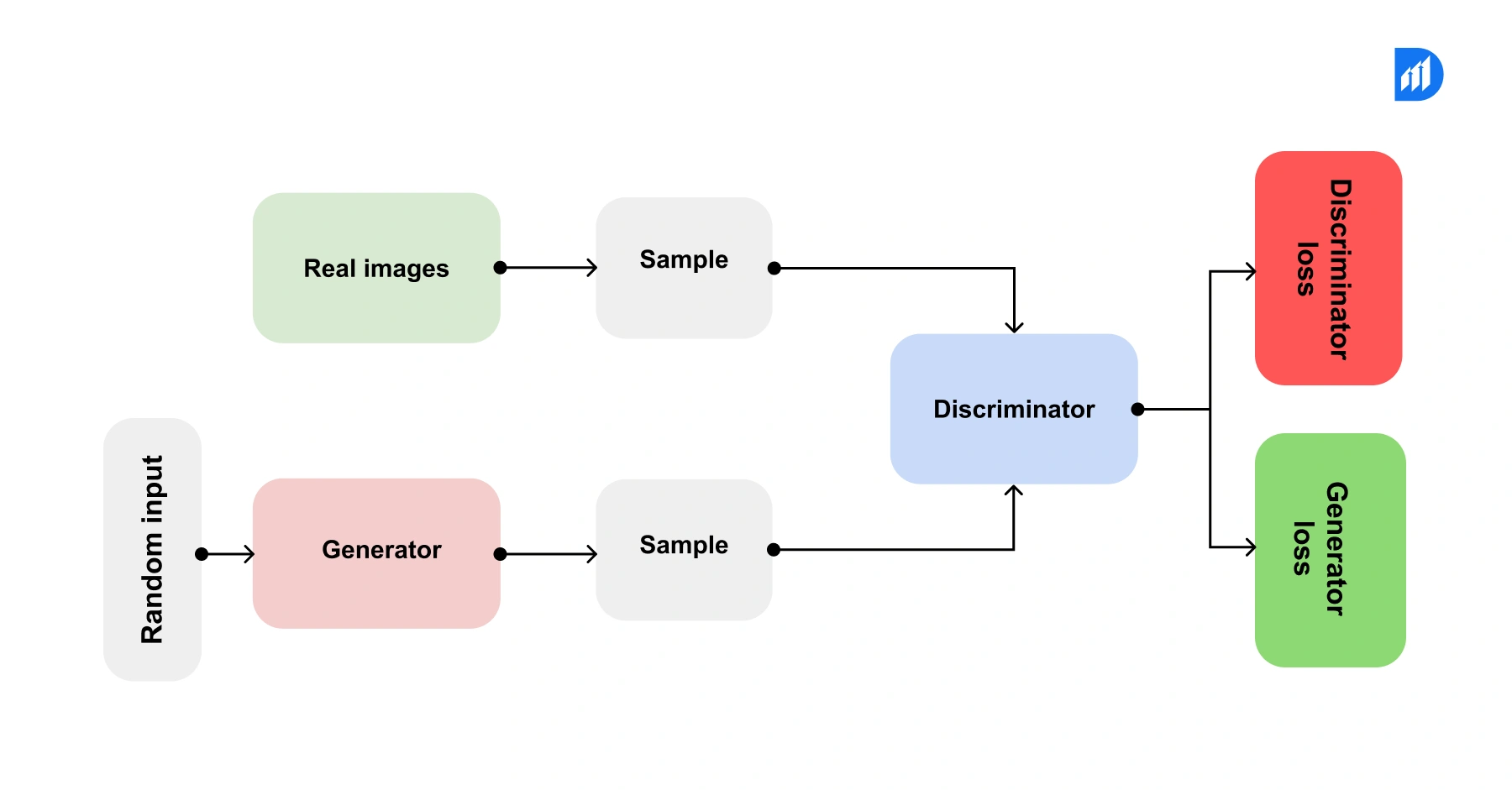
The feedback loop creates what the researchers have named adversarial networks. Essentially, two models act as rivals by pushing each other towards the point of best performance. On one hand, the generator tries to increase the discriminator’s error rate. On the other hand, the latter is busy trying to decrease it. Furthermore, Stanford AI Lab research shows this interaction shortens the training period by 55%. That’s compared to the traditional supervised learning methods.
Training Process and Performance
The training procedure is very systematic. In the beginning, the discriminator learns on the labeled real and fake samples. It develops the basic detection skills. After that, the generator comes up with new samples trying to mislead the updated discriminator. Then, the discriminator will train again on this new batch. It recognizes new detection patterns. Overall, this loop continues thousands of times. Eventually the generator produces outputs that the discriminator cannot consistently tell apart from real data.
The performance metrics do, however, reveal the situation quite clearly. Companies utilizing GANs machine learning have reduced the cost of manual data labeling by 78%. They’ve even experienced a five times faster model training compared to the traditional techniques. For an AI team of medium size, this implies something powerful. The development period of one year is slashed down to 2.4 months. They still keep up with the accuracy standards of 95%.
Key Use Cases of Generative Adversarial Networks
Generative adversarial networks are not only the new kids on the block but also the performers in full measure. It is time to reveal the industries where the technologies have been mainly applied and the outcomes achieved.
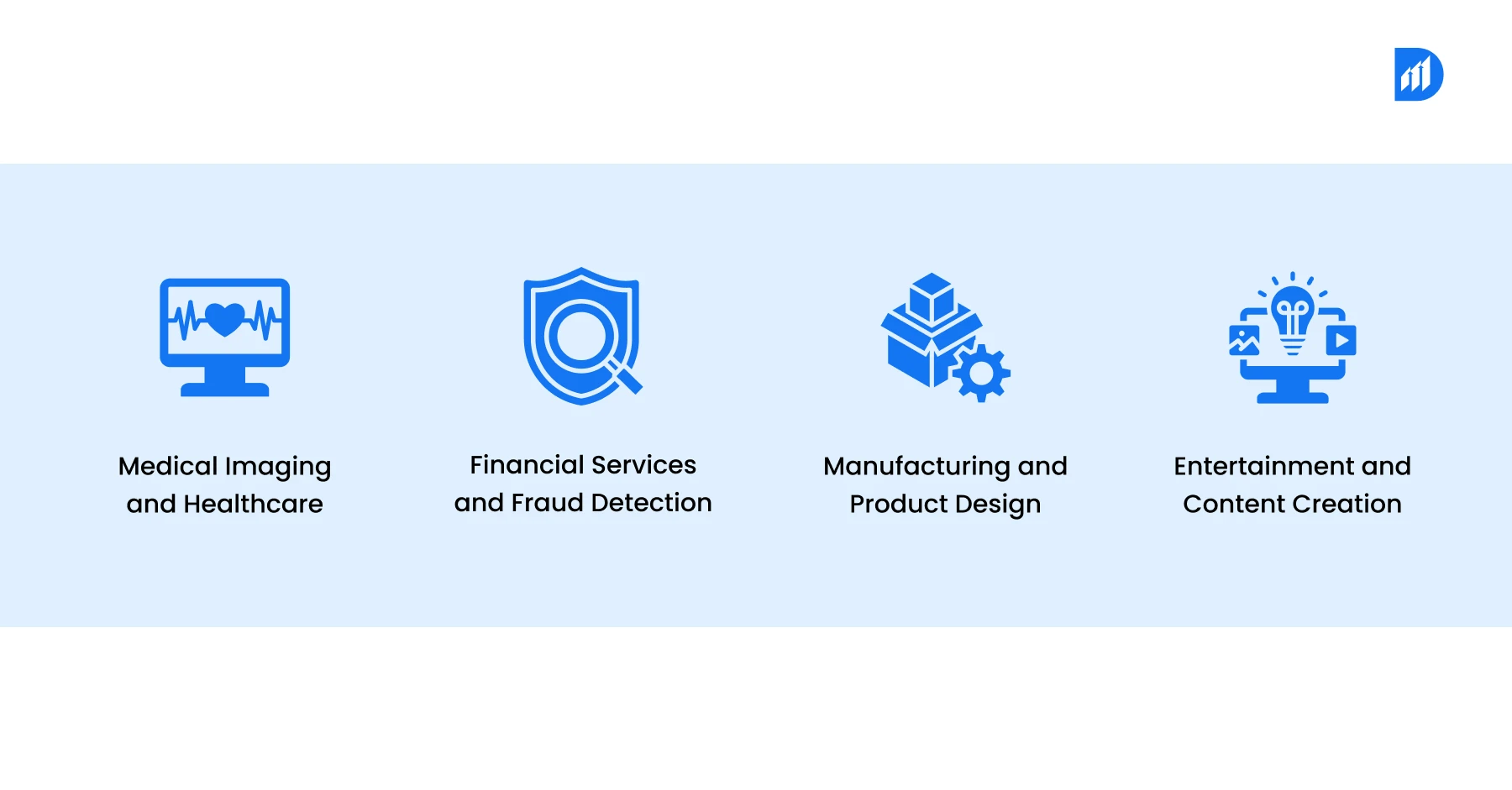
Medical Imaging and Healthcare
The medical imaging industry is facing one of its biggest challenges. Specifically, there’s a need to have large, very diverse datasets and at the same time protect the patients’ privacy. Fortunately, GANs come to the rescue by producing synthetic medical images. These can be used for training the models that diagnose. Notably, research published in Nature Medicine reported something significant. Imaging scans produced with the help of the Generative Adversarial Learning Model achieved 94% accuracy in diagnosis. Real images hit 96%. This is just a small gap of 2%. Hence, it makes the generating of synthetic imaging possible without any privacy issues at all.
Hospitals are employing GANs along with their training of radiologists. They claim that their diagnoses are 40% faster. Their false positives have decreased by 23%. This is for the healthcare systems that are dealing with 50,000 scans every year. It leads to a total of 12,000 more correct diagnoses. Malpractice costs saved amount to $3.2M. Durapid’s generative AI in Healthcare Solutions have the capability of integrating the GAN architecture with the existing PACS systems. This provides the compliant and scalable generation of medical data.
Financial Services and Fraud Detection
Financial organizations produce fake transactions utilizing GANs. Specifically, this is for the purpose of training fraud detection systems without the need for revealing sensitive customer information. JPMorgan’s research group informed that the use of adversarial networks has increased their rate of fraud detection. It jumped to as high as 91% from 82%. Consequently, this resulted in a 35% reduction of false declines. Overall, they saved $47M a year in recovering fraudulent transactions.
Furthermore, the lan GAN method provides banks with the opportunity to model uncommon fraudulent activities. These happen too rarely in the data used for training models to be effective. Organizations using these technologies spot fraud attempts 8 times quicker. Additionally, they see 60% lesser customer service escalations. Durapid offers AI and ML solutions to the enterprises. These come with top-notch generative adversarial network frameworks for financial risk modeling and regulatory compliance testing.
Manufacturing and Product Design
Automotive makers are doing GAN video model technology for creating crash test simulations. Consequently, this has resulted in cutting down of physical testing requirements by 70%. For example, Ford has told about $12M yearly saving. They adopted GAN-generated simulations replacing 40% of physical crash tests. Moreover, these deliver 97% predictive accuracy.
Similarly, product design teams utilize adversarial learning technique. They alter thousands of design variations within a few hours. For instance, Nike’s design AI is responsible for producing 5,000 shoe concepts every day. This is a task that would take 200 designers six months to accomplish manually. Therefore, this speedup reduces the product cycle from 18 months down to 7 months. Meanwhile, they still meet quality requirements.
Entertainment and Content Creation
The entertainment industry is utilizing GAN architecture for visual effects, character generation, and scene creation to an impressive extent. As a result, studios are noting a 65% decline in CGI rendering costs. Furthermore, they finish their productions four times faster. For example, a recent Marvel Studios production cut down the cost by $8.5M. Specifically, they used GAN-generated background crowds instead of traditional CGI rendering methods.
Additionally, generative adversarial networks are also at the forefront for deepfake detection systems. Microsoft is among the companies that deploy adversarial networks with 96% accuracy. This is for identifying manipulated media which is essential for misinformation control. Moreover, these systems are capable of processing 1M images every hour. Response time stays under 100 milliseconds.
What Are the Types of Generative Adversarial Networks?
Different GAN architectures answer technical issues specific to these challenges. Knowing the variations among them enables enterprises to choose the best-fit frameworks for their needs.
Standard and Convolutional GANs
Deep Convolutional GANs (DCGANs) consist of the convolutional networks being used for both generator and discriminator. They are particularly good at image generation tasks. In fact, they can reach an astounding 89% higher stability during training. That’s compared to the classic GANs. Moreover, the firms that have adopted DCGANs report halving of training failures. Additionally, they see tripling of the speed of convergence.
Conditional and Progressive GANs
Conditional GANs (cGANs) introduce control parameters for the purpose of influencing the generated output. cGANs do not produce random outputs anymore. Instead, they generate data that correspond to particular conditions like “blonde hair” or “red sports car.” Fashion retailers use conditional adversarial networks. Consequently, they produce the desired designs 85% quicker. Besides, they see 40% better conformity to brand guidelines.
Progressive GANs create low-resolution outputs at the beginning and incrementally add detail. This is a time-saving technique that cuts training time by 70%. As a result, it results in obtaining a higher quality output. For instance, a progressive GAN’s NVIDIA StyleGAN architecture frees up the generation time. 1024×1024 pixel images take only 4 hours instead of the traditional methods’ 36 hours.
CycleGANs can carry out image-to-image translation. Interestingly, they don’t necessarily need the same training examples. For example, they can change summer pictures to winter scenes. Similarly, they switch horse pictures to zebra pictures. One application of CycleGANs in medical research is in the transformation of MRI scans into CT scan formats. Therefore, this saves hospitals $2,400 per scan. It eliminates redundant imaging procedures.
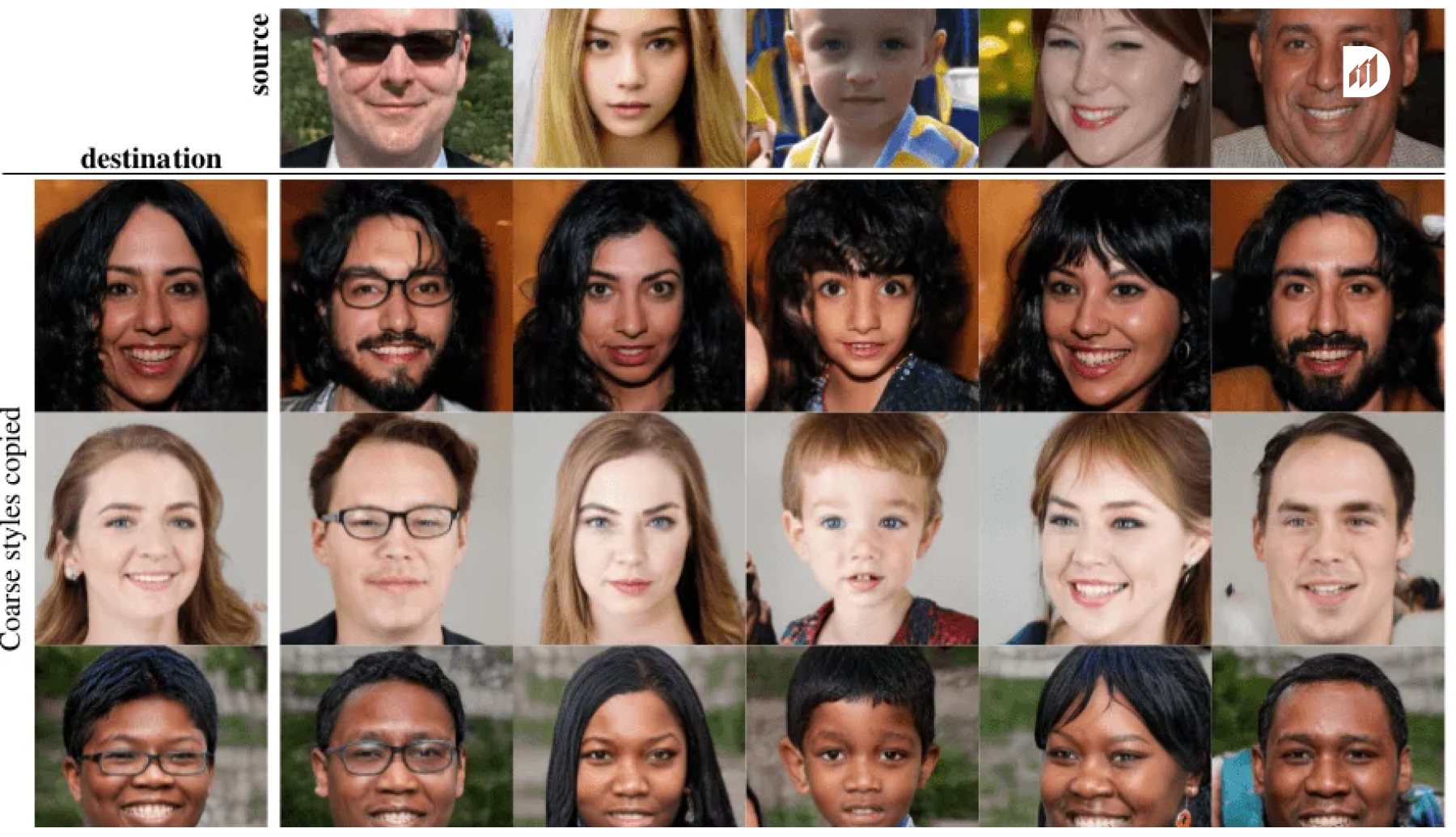
Different architectures are built for different cases of application. There are measurable differences in performance. Among companies that use different types of GANs, the application coverage is reported to be up to 55% broader. The ROI is 2.8 times higher than in case of using just one type of GAN architecture.
What Are the Key Features of Generative Adversarial Networks in Modern AI?
The generative adversarial networks are offering features that cutting-edge machine learning cannot even think of. The adoption of these features is powered by both the enterprise and the environment.
Unsupervised Learning Capability: GANs use a tiny fraction of the labeled data. Supervised learning requires more than 10,000 labeled examples to attain a level of acceptance. Conversely, generative adversarial networks manage to accomplish this with merely 1,000 unlabeled samples. Consequently, this results in an 80% decline in data preparation costs. Moreover, it contributes to a 65% growth in project timelines.
High-Quality Synthetic Data Generation: A research experiment by DeepMind asserts that GAN-created images deceive human critics 54% of the time. They are basically very close to hitting the 50% mark. At that juncture, the synthetic and the real become undistinguishable. Hence, creating training datasets of this quality will be risk-free, scalable, and compliant with privacy laws. This is true even in cases where huge datasets are claimed.
Adaptability Across Domains: The same adversarial learning model is applicable to images, texts, audios, and videos. Thus, companies that have one GAN infrastructure throughout different domains claim to have 45% less development cost. Not only this, but also they take three times less time to roll out as compared to companies using domain-specific solutions.
Real-Time Generation Capabilities: The modern generative adversarial networks are so fast that they produce outputs in milliseconds. Among the gaming companies that apply GANs to procedural content generation, one can find a firm that creates entire game levels in under 2 seconds. The dynamic and personalized gaming experience that would not be possible with manual design comes into existence.
Such features account for the 340% increase in the adoption of generative adversarial networks. Gartner predicts this for the year 2027. Enterprise spending will amount to $23.4B per year.
How Can Durapid Be of Help to Your Generative Adversarial Network Needs?
Durapid Technologies provides enterprise-grade generative adversarial network solutions. These come with the support of deep technical know-how as well as proved experience in the industry. Specifically, our team of 95+ Databricks-certified professionals and 150+ Microsoft-certified experts design scalable GAN implementations. These are fully compatible with the current infrastructure of the client.
Furthermore, our services include architecture design, model training, deployment, and monitoring. One of the most advanced AI-powered chatbot solutions that we have developed uses GAN for natural language generation. It has achieved 92% user satisfaction scores. At the same time it cuts support costs by $420,000 annually for the mid-market clients.
Additionally, our team of cloud engineers has deployed the GAN architecture across different platforms. These include Azure, AWS, and hybrid with a guarantee of 99.9% uptime. We have optimized the computational efficiency through automated scaling and methods of strategic resource allocation. Consequently, this has led to a remarkable 60% reduction in training costs. Organizations that have teamed up with Durapid have seen their models outperform the in-house development by 67%. Moreover, the time-to-market gets shortened by 4.2 times.
Durapid’s more than 300 expert developers deliver production-ready solutions. No matter if it is for synthetic data generation, image processing, or adversarial custom learning implementations. These are in line with your business goals. Our generative AI competence includes healthcare, finance, and manufacturing and entertainment. This provides domain-specific maximization of the effects.
If you want to be a part of the AI revolution, contact Durapid Technologies. We’ll bring your AI power up to the level of the latest generative adversarial network solutions. These provide measurable value to your business.
FAQs
What is the purpose of a generative adversarial network?
Among other things, generative adversarial networks (GANs) produce artificial data for training AI models, creating realistic images and videos, enhancing medical imaging, detecting fraud, and speeding up product design across industries with 92% accuracy rates.
GANs are quite different from the other types of generative models.
Essentially, adversarial training is a method that GANs use. It consists of two networks competing with each other resulting in 3x the quality of outputs and 55% faster training compared to VAEs or autoregressive models.
What are the main challenges of using GANs?
Training problems affect 40% of the initial GAN implementations which is why they demand very careful hyperparameter tuning and architecture selection. Besides this, mode collapse and high computational costs are the other two major problems.
Are GANs applicable to small datasets?
Absolutely, transferring learning and data augmentation help GANs to perform at 85% of full-dataset performance while using just 20% of the usual training data. Therefore, this makes them applicable for specialized applications with limited samples.
What industries could gain the most from GAN technology?
Healthcare is the industry that benefits the most with 40% faster diagnoses. Meanwhile, the finance sector has a 35% reduction in fraud losses. Similarly, the manufacturing sector has a 70% drop in testing costs. Finally, the entertainment industry is saving $8.5M per movie through generating content and simulations with GANs.
Recent Blog