E-Commerce AI Agents: Customer Support Automation Cost & ROI Analysis
At 2:13 a.m., someone is still scrolling your store. They’ve queries related to size or shipping. Or whether the product will arrive on time. In a physical store, that scenario would be simple. A salesperson would walk over and help. In e-commerce, that scenario often becomes a support ticket. And support tickets don’t always come at convenient hours.
This is where ecommerce AI agents quietly begin to reshape how online stores operate.
In an Ecommerce vs Retail Store world, the difference is simple. A retail store has a salesperson standing nearby. An online store usually has a support ticket waiting in a queue.
Instead of waiting for human agents to log in and clear backlogs, many brands now deploy AI agents for their ecommerce stores that answer customer questions instantly. They track orders, resolve common issues, and guide shoppers toward the right products. The shift is bigger than basic chatbots.
Modern ai ecommerce systems use conversational intelligence, order data, along with customer behavior signals to deliver support that feels fast, contextual, and increasingly human. In the emerging world of agentic AI commerce, these systems are not just responding to questions, they are actively helping customers complete purchases. Agentic ai commerce is reshaping what ai for consumers actually looks like at the point of sale.
Why This Matters for Your Business Now?
For businesses, the question is no longer whether AI support automation works. The real question is: what does it actually cost, and what kind of ROI can you expect? Because while the promise of ecommerce ai agents sounds impressive: 24/7 support, lower costs, faster response times, decision makers still need clear numbers. How much does implementation cost? How much can businesses realistically save? And where do AI agents for ecommerce outperform traditional support teams?
Your customer support team handles 3,000 tickets a day. Half of them ask the same five questions. Your agents burn out, response times surge, and customers leave. This is where ecommerce AI agents step in.
Not as a futuristic experiment. As a practical operational fix many companies already deploy at scale.
According to Gartner’s 2024 Customer Service Report, businesses that introduce AI into customer support reduce operational costs by up to 30%, while first-response resolution rates improve by around 25%.
In this guide, we break down the true cost of implementing ecommerce AI agents, the ROI benchmarks businesses are seeing today, and the metrics that actually matter when evaluating AI-powered customer support. Whether you are comparing the best ecommerce tools, exploring what AI for consumers looks like in real customer interactions, or seeing how innovations like AI in Product Development shape modern digital businesses, this breakdown focuses on the numbers that matter.
What Are E-Commerce AI Agents for Customer Support?
The software systems known as ecommerce AI agents operate autonomously to manage customer interactions which include order status inquiries, refund processing, and complex complaint resolution. Modern AI agents for ecommerce do much more than follow scripted replies.
They use large language models with intent recognition to understand customer context and deliver accurate responses. Unlike basic chatbots that follow fixed decision paths, these systems connect directly with tools like your CRM, order management system, and helpdesk platforms such as Zendesk or Freshdesk.
This shift mirrors what businesses are already seeing with AI in Manufacturing, where intelligent systems replace rigid workflows with smarter automation.
The system retrieves current data about shipping progress, inventory status, and payment information to deliver authentic answers instead of using standard responses. Most platforms function through three main elements: a natural language understanding (NLU) component, a business logic system that connects to your internal APIs, and a human escalation system for handling difficult situations. The ecommerce AI system uses this design to handle around 60 to 80 percent of support requests without needing any human assistance.
How Much Does Implementing an AI Support Agent Actually Cost?
The first question operations leaders ask concerns cost. There are three components to break down: platform fees, integration work, and ongoing maintenance. Platform licensing runs between $500 to $5,000 per month based on ticket volume and available features. Salesforce Einstein and Intercom provide enterprise solutions which start at $10,000 per month. Mid-market tools like Tidio, Gorgias, and Re:amaze sit in the $300–$1,500 range.
The integration and setup process requires a one-time investment of $8,000 to $40,000. This package includes API connections to your Shopify, Magento, or WooCommerce store, data pipeline configuration, plus agent training on your product catalog. Ongoing maintenance activities: model fine-tuning, prompt updates, and QA result in a monthly cost ranging from $1,000 to $3,000 for a mid-size store. The total first-year investment for a mid-market ecommerce business varies between $25,000 and $80,000.
Breaking Down the ROI: What Returns Can You Realistically Expect?
ROI from ecommerce AI agents comes from three areas: lower labor expenses, improved customer service that reduces cart abandonment, and continuous system operation that generates income during non-business hours.
A 10-member support team costs approximately $350,000 annually: salaries, benefits, training, plus management overhead. When an AI agent handles 70 percent of tickets, that equivalent cost drops to around $120,000, resulting in annual savings of $230,000. Forrester Research discovered that companies save $1.4 million every year when agents reduce average handling time by just two minutes. AI agents shorten handling time for common requests by 40 to 60 percent because they provide instant data access.
Businesses that implement AI customer support experience a 15 percent decrease in customer turnover because their customers receive quicker answers. The $50,000 implementation project will generate a return on investment of three to five times within 12 months, with the investment recovered in six to nine months.
Key Metrics to Measure AI Customer Support Performance
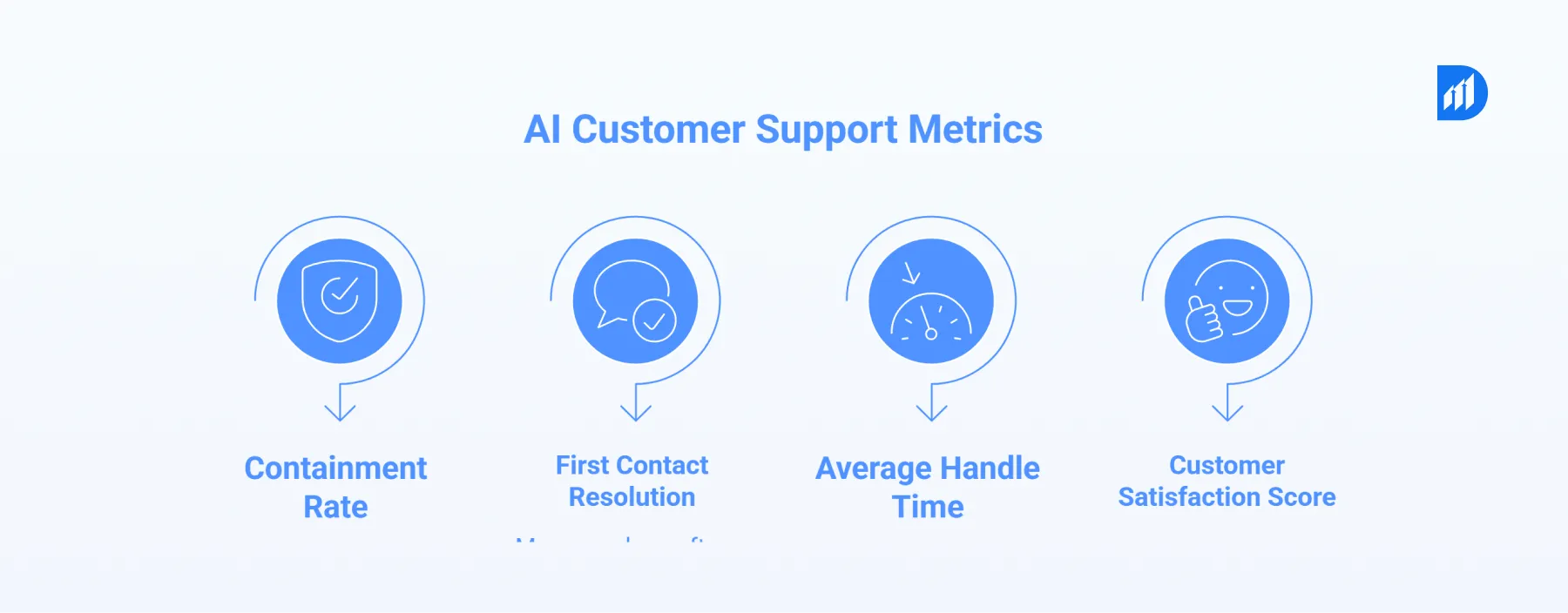
You cannot improve what you never pause to measure. When businesses adopt ecommerce AI agents, the real story is not just in technology. It lives in the numbers that quietly change behind the scenes. These metrics show whether your ecommerce AI system is simply answering messages or actually transforming how customer support works.
Containment Rate
This metric shows how many customer conversations your AI can resolve completely on its own, without passing the issue to a human agent. For most stores implementing ecommerce AI agents, a healthy containment rate begins to appear within the first few months. Well-trained systems typically resolve 65–75% of support tickets independently within 90 days of deployment. If containment stays below 50%, it usually signals something important: the AI may need better training data, deeper integrations with order systems, or clearer workflows.
First Contact Resolution (FCR)
First Contact Resolution measures how often a customer’s problem gets solved in the very first interaction. No follow-ups. No repeated explanations. Just a clean resolution on the first try. High-performing AI agents for ecommerce now achieve 72–80% FCR, which is noticeably higher than the 58% industry average for human support teams, according to ICMI’s 2024 benchmark. In simple terms, fewer conversations turn into long support threads.
Average Handle Time (AHT)
Average Handle Time tells a very practical story: how long it takes to resolve a customer request. Human agents typically spend 6–8 minutes per support ticket, especially when they need to check order details, verify shipping information, or navigate multiple tools. Routine questions handled by ecommerce AI agents such as order tracking, return policies, or delivery timelines are often resolved in under 90 seconds. Multiply that time difference across thousands of conversations, and the operational impact becomes obvious.
Customer Satisfaction Score (CSAT)
Speed matters more than most businesses expect. Customers often value quick answers even more than perfectly detailed ones. That is where AI ecommerce support systems begin to shine. The reason is simple: customers receive help immediately, instead of waiting in line for the next available agent. When businesses track these metrics consistently, ecommerce AI agents stop being a technology experiment and start becoming a measurable growth system.
AI vs. Human Agents: A Side-by-Side Cost Comparison
Numbers make things easier to understand. When businesses evaluate the performance of ecommerce AI agents, the real clarity often appears when you place the numbers side by side. For a mid-sized online store handling around 5,000 customer support tickets every month, the difference between traditional support teams and an AI support system becomes very visible.
| Metric | Human Agent Team | AI Agent System |
| Monthly cost | $28,000–$35,000 | $3,000–$6,000 |
| Average response time | 4–8 hours | Under 60 seconds |
| Tickets resolved per hour | 8–12 | 200–500 |
| Availability | 8–10 hours/day | 24/7/365 days |
| Scalability during peaks | Requires hiring | Instant scaling |
| CSAT score (average) | 3.9/5 | 4.1–4.3/5 |
The comparison tells a clear story. But the most effective support operations rarely replace people entirely. Instead, they evolve into a smarter structure. Many businesses using ecommerce AI agents now operate with a hybrid support model.
In this system, the AI handles tier-1 support requests: order tracking, shipping updates, return policies, and common product questions. More complex tier-2 issues are flagged for human agents, who review the conversation with context already available. And when deeper expertise is required, tier-3 cases move to senior support specialists.
This structure creates a strong balance between automation and human judgment. In many cases, companies see support team sizes reduce by 40–60%, while response quality, speed, and customer satisfaction improve across every level of support.
Which E-Commerce Businesses Benefit Most from AI Support Automation?
Not all businesses have reached the appropriate point to implement complete AI systems. When you identify your current position, you will avoid wasting resources on systems which provide only minimal benefits. High-volume stores (10,000+ monthly tickets) see the strongest ROI because fixed platform costs spread across more interactions. The advantage of reduced per-ticket expenses decreases as volume levels drop.
Stores which experience repetitive customer inquiries achieve maximum benefits. AI can address most customer inquiries which exceed 60% about order status, shipping, returns, and size guides without needing extensive modifications. Businesses running agentic commerce workflows where AI agents take actions, not just answer questions, gain additional leverage. The complete workflow can be handled by an agent which processes returns, activates refunds, and dispatches confirmation emails through a single interaction.
This is one reason agentic commerce is now appearing on every shortlist of best ecommerce tools for scaling brands. Stores in fashion, electronics, health, and home goods report the strongest results. When evaluating the best ecommerce tools for support automation, 24/7 AI availability is a competitive necessity for anyone running flash sales or managing ai for consumers across multiple time zones.
Real-World Case Studies: Cost Savings and ROI Benchmarks
A mid-sized UK fashion brand handling 8,000 monthly tickets implemented Gorgias AI during the first quarter of 2024. Within 60 days, the system hit a 71% containment rate. Monthly support expenses dropped from £22,000 to £7,400. Customer satisfaction scores climbed from 3.8 to 4.4 because response times fell from 6 hours to under 3 minutes.
A North American electronics retailer processing 25,000 tickets per month adopted Salesforce Einstein alongside a tailored OMS integration. In year one, AI resolved 74% of all tickets. That led to a workforce reduction from 45 agents to 18, with annual savings of $1.2 million against implementation costs of $340,000.
McKinsey’s 2024 analysis of AI in retail found companies with mature AI support workflows report 20–30% lower service costs within 18 months.
How to Choose the Right AI Agent for Your E-Commerce Store?
Picking the wrong platform costs more in wasted integration work than the platform itself. For businesses exploring agentic commerce at scale, here are the factors that separate deployments which grow from those which stall.
Native Integrations
Native integrations are the first thing to check. Your AI agent needs direct connections to your ecommerce platform and OMS. Gorgias works best for Shopify. Freshdesk suits Magento and WooCommerce. Salesforce Einstein fits enterprise SAP environments. Without the right fit, businesses end up paying for custom API solutions that double implementation costs.
Escalation Logic and Pricing
CSAT results depend on escalation processes. Customer trust breaks when AI systems hold tickets too long before transferring them to human agents. Look for platforms with configurable triggers based on sentiment scores, ticket age, and keyword detection.
Pricing models also matter for long-term cost. Per-resolution pricing works well for low-to-mid volumes. Per-seat or flat monthly models favor high-volume operations. Calculate your projected monthly ticket volume before committing.
Companies that use AI marketing agents to automate their campaigns should choose platforms which offer shared data connections between support and marketing AI. A customer with a delayed shipment should not receive a promotional email the same day.
Frequently Asked Questions
How long does it take to deploy an ecommerce AI agent?
Most ecommerce AI agents go live within 4–8 weeks, including integration, training, and testing. Enterprise setups with complex order management systems may take 12–16 weeks.
Can AI agents handle returns and refunds autonomously?
Yes, modern AI agents for ecommerce can trigger refund workflows and generate return labels automatically. This works smoothly when your return policies and rules are clearly configured in the system.
What is a good containment rate for ecommerce AI agents?
A strong containment rate usually falls between 65–75%. If it drops below 50%, it often signals missing integrations or weak training data.
Will AI agents hurt the CSAT scores?
In most cases, CSAT actually improves after introducing AI ecommerce support. Businesses often see scores rise 0.2–0.5 points within 90 days because response times become much faster.
Do ecommerce AI agents work for small businesses?
For stores handling fewer than 1,000 tickets per month, ROI may be limited. The real financial impact appears once businesses cross 2,000+ monthly support tickets. For smaller stores, agentic ai commerce tools focused on ai for consumers can still add meaningful value through faster response times alone.

Deepesh Jain
Recent Blog

Top 10 AI Agent Tools: Features, Pros, Cons & Comparison
March 9, 2026