Digital Customer Onboarding: The Next Leap in Modern BFSI Industry

Somewhere between a customer opening a bank account in five minutes and a bank trying to verify that customer in fifty steps lies one of the biggest shifts happening in the BFSI industry today. Customers no longer walk into branches with folders of documents and patience. They arrive through apps, websites, and digital journeys. They expect instant verification, seamless sign-ups, and a process that feels as smooth as ordering food online. This shift has pushed financial institutions to rethink the way they welcome new customers. That is where digital customer onboarding is quietly reshaping the banking experience.
From identity verification to compliance checks to fraud prevention and customer verification, banks are now designing onboarding journeys that are faster, safer plus fully digital. The goal is simple: reduce friction, lower bank customer acquisition cost, and create a first experience that builds trust from the very beginning. This change is also being driven by a new generation of users. Gen Z banking behavior shows a clear preference for mobile-first, instant, and intuitive financial services. For them, waiting days to open an account is not just inconvenient. It feels outdated.
As a result, financial institutions are turning to technology, data, and intelligent automation to transform customer acquisition in banking. Digital onboarding has moved beyond being a convenience. It is now becoming a competitive advantage for organizations across the BFSI industry. In this blog, we explore how digital customer onboarding banking solutions are evolving, what technologies are powering them, and why this shift is becoming the next leap in modern financial services.
Why Traditional Onboarding Breaks at Scale
Digital customer onboarding has become an essential requirement for all BFSI institutions. The system functions as the primary point through which customers experience their entire journey with the bank. Financial institutions that operate through paper documents and physical locations will see a gradual decline in their market presence. EY’s 2024 research makes this clear: 67% of banking customers will abandon the onboarding process when it exceeds 10 minutes. The situation does not involve a user experience issue. It creates a direct obstacle to revenue growth.
Traditional banking institutions developed their customer onboarding systems to meet regulatory requirements. A bank branch process requires 6 to 9 manual steps: document submission, identity verification, credit checks, KYC review, account setup, product assignment, and welcome communication. Each step exists within its own system. The various systems belong to distinct administrators.
The separation of systems leads to significant operational slowdowns. Operations teams spend 60% of their total onboarding time on data entry and validation tasks that AI can complete within seconds. The customer, meanwhile, needs to wait. Waiting becomes the quickest method for banks to lose potential Gen Z banking customers. Generation Z now makes up 27% of new account openers globally. On top of that, 81% of them expect a fully mobile account opening experience.
The situation becomes more complicated because of fraud. Manual KYC processes fail to detect 30% of synthetic identity fraud cases. In contrast, AI-based verification systems successfully identify 94% of them. The distance between human assessment and machine-based screening determines whether your business absorbs losses or prevents them.
What Digital Customer Onboarding Actually Looks Like
True digital customer onboarding is not a PDF form on a website. It is an end-to-end, automated journey that connects identity verification, KYC/AML compliance, credit decisioning, and account activation into a single continuous workflow. Here is what that architecture looks like in practice:
| Stage | Traditional Process | Digital Onboarding |
| Identity Verification | Branch visit, 2–3 days | eKYC with biometrics, under 2 minutes |
| Document Collection | Physical forms, manual scanning | AI-powered OCR + auto-fill |
| Credit Assessment | Manual review, 24–48 hours | Automated decisioning, real-time |
| Account Activation | 1–3 business days | Instant, end-to-end automated |
| Customer Acquisition Cost | $250–$400 per customer | $80–$130 per customer |
The table above shows the operational shift clearly. Digital onboarding cuts bank customer acquisition cost by up to 68% while compressing activation timelines from days to seconds. This is what modern BFSI institutions are competing on.
Core Technologies Powering BFSI Digital Onboarding
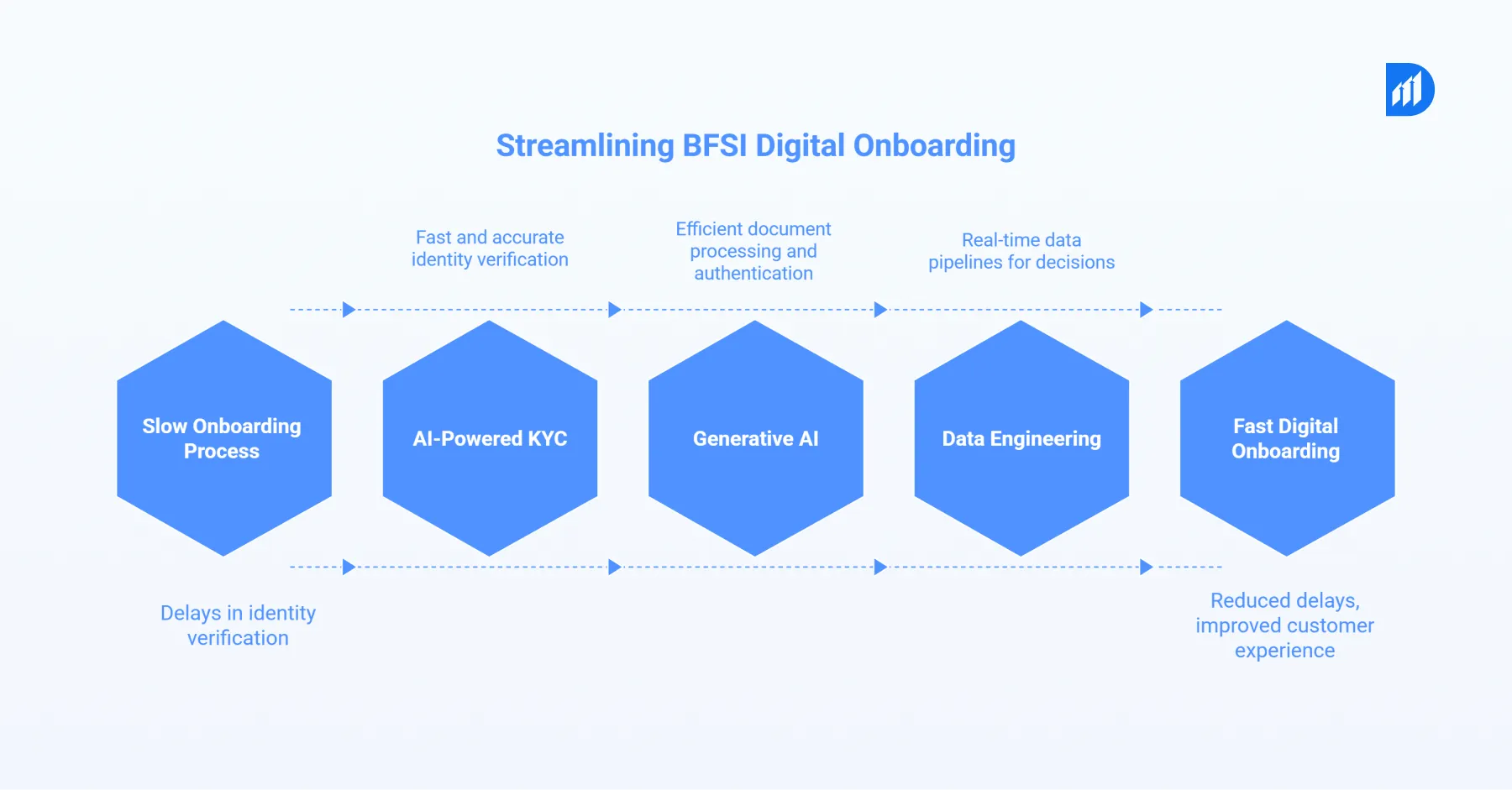
The process of developing a successful digital onboarding system needs more than just a mobile application. The system needs an infrastructure that consists of multiple technology layers, where each component serves specific compliance and experience functions.
AI-Powered KYC and Identity Verification
The eKYC systems of today use facial recognition together with liveness detection and document OCR to complete identity verification within 90 seconds. Platforms like Onfido and Jumio reach 99.7% accuracy when verifying government-issued identification documents. For BFSI institutions, this removes the single biggest delay in the onboarding chain.
Durapid extends this further through its AI capabilities for fraud detection. Banks layer behavioral biometrics with device fingerprinting onto identity checks to catch fraudulent account creation that standard KYC procedures miss entirely.
Generative AI for Document Processing
Large language models now process unstructured documents with high accuracy. Generative AI models extract, categorize, and authenticate income documents, utility bills, and financial statements 40 times faster than human auditors. For high-volume banks, this compresses a two-day turnaround into roughly two hours.
Data Engineering and Real-Time Pipelines
Onboarding generates data across dozens of customer interaction points. Data engineering services connect CRM systems with core banking, compliance, and analytics platforms so every decision uses the latest customer information. Streaming pipelines built on Apache Kafka reduce data latency from hours to milliseconds, enabling real-time credit assessments at scale.
The Gen Z Factor: Why Speed Defines Customer Acquisition in Banking
Gen Z banking expectations have fundamentally changed how financial institutions compete for new customers. This demographic checks three things before completing any financial form: how long it takes, whether it requires a branch visit, and whether a phone camera handles the ID check.
Banks that pass all three criteria see 3.4x higher application completion rates than those that fail even one. The commercial impact is significant. Every 1% improvement in onboarding completion rate for a mid-sized bank translates to approximately $4.2 million in annual revenue from new accounts.
This is also where enterprise software development becomes critical. Custom onboarding platforms built on microservices architecture allow BFSI firms to iterate faster, test onboarding flows, and track customer drop-off signals in real time. Off-the-shelf solutions rarely provide this level of control.
When Digital Onboarding Does Not Work: The Limitations to Know
Not every onboarding scenario benefits from full automation. High-net-worth clients usually prefer a relationship-based approach that involves working directly with a personal advisor. Forcing a self-service journey onto this group leads to higher abandonment rates.
Complex institutional onboarding, which involves multiple beneficial owners, cross-border KYC, and special product setups, still needs human judgment at key decision points. The goal is not to remove all human involvement. It is to eliminate unnecessary human touchpoints from routine processes.
Hybrid models produce better results than either extreme. McKinsey research shows that banks using human-in-the-loop AI for onboarding achieve 22% higher completion rates for complex products compared to fully automated journeys.
Compliance Architecture: Building Onboarding That Regulators Trust
One reason many digital customer onboarding projects stall is compliance anxiety. Teams build the customer experience but underestimate the regulatory framework required to support it. In India’s BFSI sector, Video KYC under RBI guidelines, Aadhaar-based eKYC, and PMLA compliance each add distinct technical requirements to the onboarding stack.
Separating the Journey from the Engine
A well-designed compliance architecture separates the customer journey layer from the compliance engine. The customer sees a smooth four-step process. Behind the scenes, the system runs parallel checks across PEP screening, sanctions lists, adverse media databases, and credit bureaus simultaneously.
Durapid’s technology stack includes pre-built connectors for CERSAI, CIBIL, and bureau-level integrations that cut compliance implementation time by 60%. This means faster go-live without compromising on regulatory coverage.
Voice Agents and Conversational AI in Onboarding
The next evolution in digital customer onboarding banking is conversational. Voice agents now guide customers through the onboarding process in their preferred language, answering questions, collecting data, and triggering verification flows without any human agent involvement.
The same technology that healthcare voice agents use for patient intake works effectively in banking. A customer calling a bank’s helpline gets walked through account opening in one 8-minute call. No branch visit, no callback, no paper documentation.
Early adopters report a 28% improvement in onboarding completion rates when voice-assisted flows are offered alongside mobile apps. The channel works particularly well for customers in Tier 2 and Tier 3 cities, where app adoption is lower but smartphone usage is growing fast.
Measuring the ROI of Digital Onboarding: What the Numbers Actually Say
The bank customer acquisition cost for a fully manual process averages between $250 and $400 per new customer. Digital onboarding brings this down to $80 to $130. For a bank onboarding 50,000 new accounts annually, that is $6 million to $13 million in savings each year.
Faster digital customer onboarding also turns customer acquisition in banking into a competitive advantage. Banks with sub-5-minute digital journeys see a 34% higher 90-day activation rate. Activated customers generate 3x more revenue in the first year than those who never completed account setup.
LMS for BFSI industry platforms that integrate with onboarding systems show an added benefit too. New employees trained on digital compliance workflows make 45% fewer KYC errors. This connects internal training investment directly to onboarding quality outcomes.
Frequently Asked Questions
What is digital customer onboarding in the BFSI industry?
Digital customer onboarding allows banks to bring new customers on board through mobile-first, automated processes that handle KYC, identity verification, and account setup online. Instead of branch visits and paperwork, the entire journey happens digitally within minutes.
How does digital onboarding reduce bank customer acquisition cost?
Automation replaces manual document checks and operational steps, significantly lowering onboarding expenses. As a result, the bank customer acquisition cost drops while banks onboard customers faster and more efficiently.
What compliance requirements apply to digital onboarding in India’s BFSI sector?
Financial institutions must follow RBI regulations such as Video KYC, Aadhaar-based eKYC, and PMLA guidelines. These ensure proper identity verification, compliance checks, and secure audit trails during onboarding.
How does generative AI improve digital onboarding for banks?
Generative AI speeds up document extraction and validation while enabling conversational onboarding journeys. This reduces processing time and helps banks lower customer drop-offs during account creation.
When should banks not use fully automated digital onboarding?
Fully automated onboarding works best for standard retail customers. For high-net-worth clients, corporate accounts, or complex cross-border cases, a human-assisted approach is often more effective.
Durapid Technologies builds enterprise-grade digital onboarding solutions for banks, NBFCs, and insurance providers. With 95+ Databricks-certified professionals and deep BFSI domain expertise, our teams deliver compliant, scalable onboarding architectures that reduce acquisition costs and accelerate time-to-revenue.
Recent Blog