AI Marketing Agents: Everything You Need to Know
Just imagine that your marketing department starts a new campaign at 9 AM. After only 15 minutes, an AI Marketing Agent has not only completed the gathering of customer reactions across 12 different platforms, but he has also changed the advertising expenditure by $3,400 solely on the basis of the instant performance metrics and finally created 847 email sequences according to the individual customers’ previous internet usage. On the other hand, competitors relying on the traditional method are still patiently waiting for yesterday’s analytics report to get opened.
Companies equipped with AI Marketing Agents enjoy 32% superior campaign ROI and 45% quicker time-to-market than those who resort to manual workflows according to McKinsey’s 2024 Marketing Technology Report. The AI agents market is expected to be worth $47.1 billion by 2030. Marketing automation is the biggest growth segment at 38% CAGR. This trend is not about replacing workers but rather making more efficient what is already good and discarding what is not.
So what exactly is an AI Marketing Agent?
An AI Marketing Agent is a self-directed software application that carries out marketing work. It uses machine learning, natural language processing, and decision-making algorithms with little to no human oversight. These agents, unlike rule-based marketing automation tools that obey set workflows, monitor data live, make their own calls, and adjust tactics according to the results of the performance.
The AI agent definition includes more than just simple automation. These systems bring together three key parts: perception (gathering of data from various sources), cognition (recognizing patterns and forecasting through analysis), and action (performing marketing tasks on their own). A regular chatbot sticks to the scripts its been given. An AI Marketing Agent using Gen AI Chatbot Development frameworks, however, knows the context, adapts from the interactions, and changes the replies according to customer mood and the likelihood of conversion.
The marketing automation platforms manage 2.4 million tasks every month for the large clients. AI Marketing Agents can manage 10 times that quantity without any error. According to Gartner’s 2024 AI Operations benchmark study, their error rate has been coming down from 8% to 0.3%.
An Overview of the Major Components of AI Marketing Agents
All the powerful AI Marketing Agents rely on four distinct but integrated systems, which cooperate in their drives for marketing effectiveness.
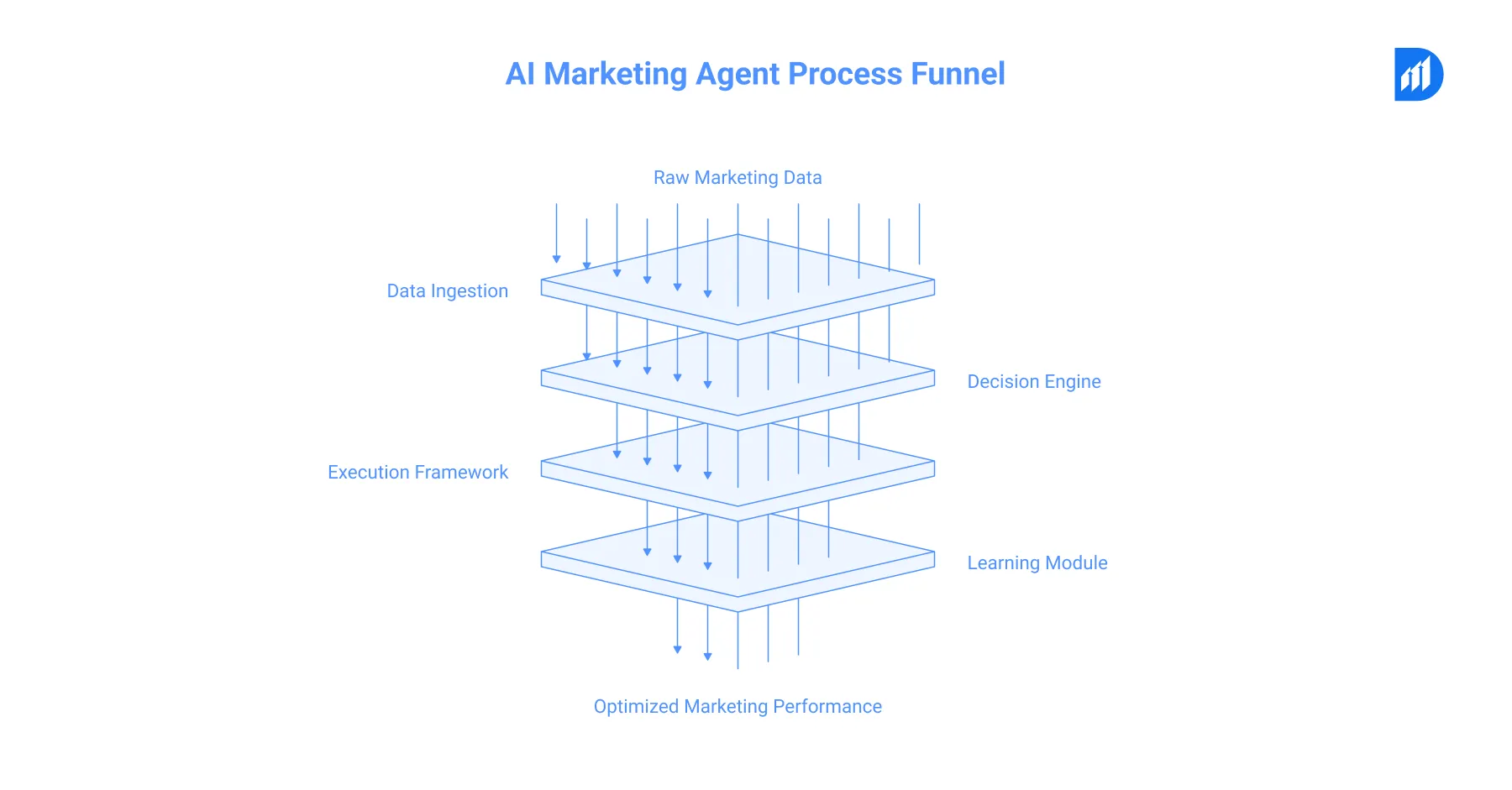
Data Ingestion Layer
The data ingestion layer captures data from CRM systems, social media, website analytics, email marketing and ads platforms. The agents process both structured data, for instance, purchase history, and unstructured data, for example, customer support chats. For instance, in the case of a mid-sized e-commerce business, this would mean processing 340,000 daily customer interactions. A human team could only manually check 12,000.
Decision Engine
The decision engine uses the machine learning model. Teams have trained it on past campaign data. When an AI Marketing Agent finds that in the tech sector email open rates are dropping by 23% for subject lines longer than 50 characters, it right away changes the templates for all the active campaigns. This whole process takes place within 90 seconds of pattern detection—traditional A/B testing would take 3-4 weeks to come to the same conclusion.
Execution Framework
The execution framework connects to the marketing tech stack through APIs. The agents can buy and adjust the Google Ads, post social media posts, segment audiences in HubSpot or Salesforce, and start the email sequences—all done on their own. One financial services client was able to lower his cost-per-acquisition from $127 to $84. They used their AI Marketing Agent to optimize bidding strategies across 47 campaigns at the same time.
Learning Module
The learning module keeps raising performance through reinforcement learning. Processing of 1 million customer interactions results in an increase in accuracy rates for content recommendations from 61% to 89%, as reported in the Journal of Marketing Technology.
When to Employ AI Marketing Agents
AI Marketing Agents provide the highest return when your marketing process has particular international or tricky issues that no manual ways of working can solve well.
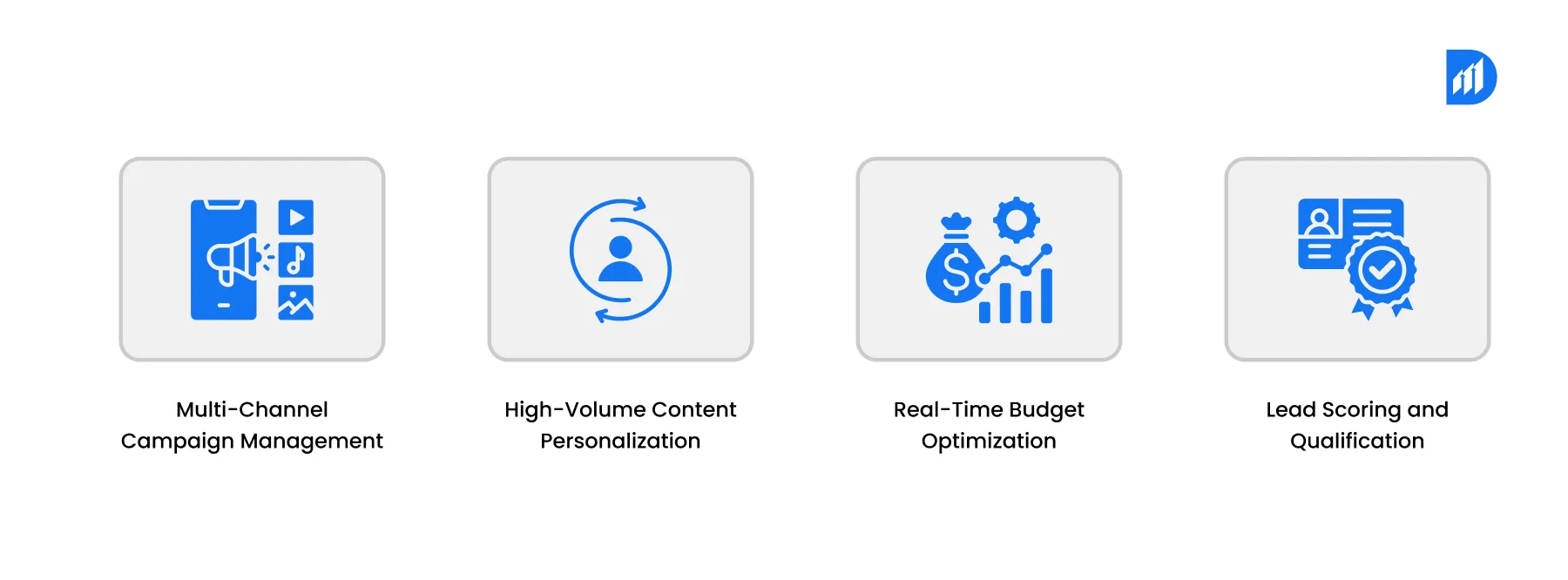
Multi-Channel Campaign Management
Teams should deploy agentic ai for marketing when they are running multi-channel campaigns across more than 5 platforms. Manually coordinating the messaging, timing, and budget allocation through Facebook, Google, LinkedIn, email, and website personalization leads to gaps in consistency. According to Adobe’s 2024 Marketing Operations Report, companies using ai agents in marketing experience 67% less inconsistency in their brand messages than those who rely on manual coordination.
High-Volume Content Personalization
AI agents are a must in very demanding content personalization. It will be impossible to scale if you have many audience segments (10+) and need to customize landing pages, emails, or product recommendations. Retail companies that use AI Marketing Agents for ai ecommerce personalization report getting 28% more conversion rates and 34% larger average order values compared to the previously set static experiences.
Real-Time Budget Optimization
Continuous budget optimization in real-time is a function that requires self-ruling decision-making. Marketing department organized in the traditional way would look at performance of the campaign every week or every day. On the other hand, AI Marketing Agents keep adjusting the spend every 15 minutes, based on the set performance thresholds. This level of responsiveness results in a 19% higher return on internet advertising spend for companies that have $100,000+ monthly advertising budgets.
Lead Scoring and Qualification
AI agents are a huge help in the lead scoring and qualification process, especially when sales teams deal with more than 500 leads a month. The agents quickly find the top scores among the lead by looking at 47 behavioral signals. Human teams usually keep track of only 6-8 variables. According to the study by Forrester’s B2B Marketing Technology, sales teams dealing with AI-qualified leads close deals 41% faster.
When NOT to Use AI Marketing Agents
Even though AI Marketing Agents have great powers, you can’t use them in every marketing scenario. Understanding the limits will prevent wastage of resources and will also help in setting the right expectations.
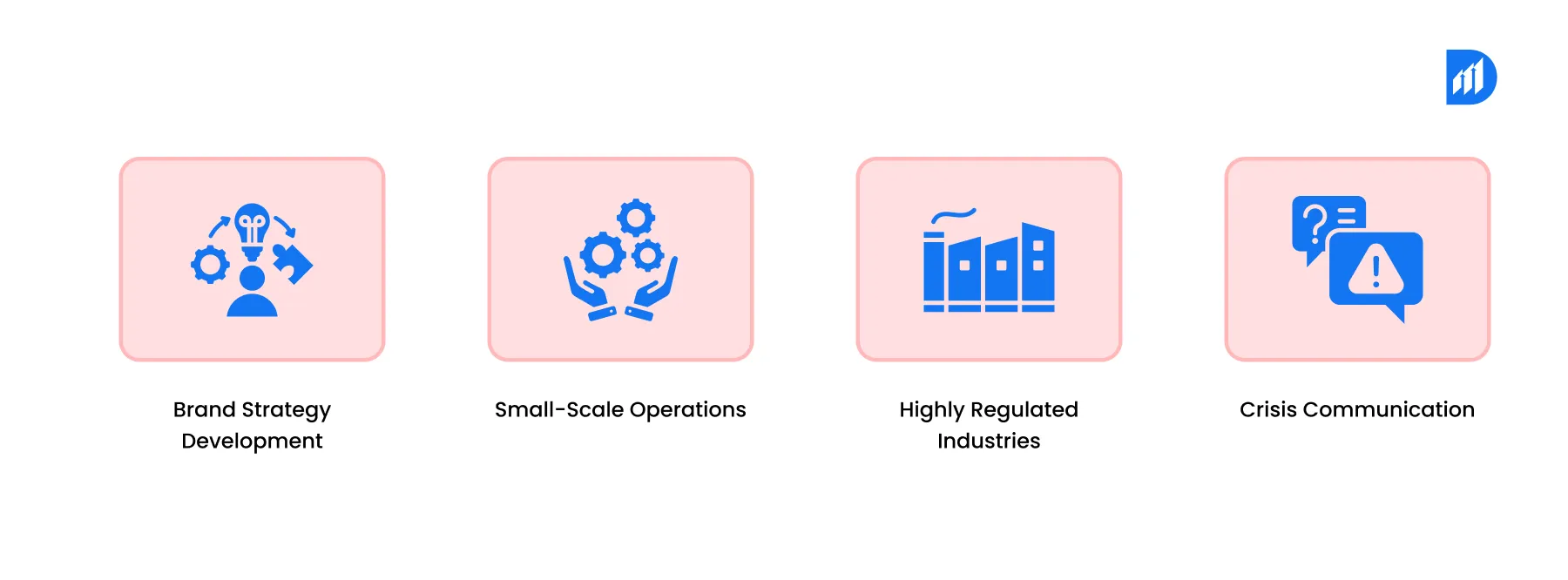
Brand Strategy Development
Do not use AI agents in the development of brand strategy and creative conceptualization. The agents shine in the area of optimizing the already-existing campaigns but they will not be able to come up with the out-of-the-box creative concepts or find the brand’s place in the market. The 2024 Creative Marketing Impact Study reported that human-led creative strategy is 73% more effective than AI-generated concepts with respect to brand recall and 84% in emotional connection.
Small-Scale Operations
Companies operating on a small scale will not be able to reap the benefits of AI agents. This means having less than 1,000 visitors to their website per month or having very little marketing data. These systems need lots of past data for training purposes. Companies with less than 6 months of marketing data or having fewer than 10,000 customer records see hardly any ROI improvement—often less than 5%. The agents have not enough training data and hence, they cannot be efficient.
Highly Regulated Industries
Heavily regulated sectors that have compliance as a top priority may find it hard to keep a balance. The freedom of an agent and the needed human watching must work together. In the cases of healthcare marketing, financial services advertising, and pharmaceutical promotions a legal review is needed. AI agents can’t provide such review in a trustworthy way. A healthcare client stopped the use of their online marketing agent after 3 months. The automated content generation produced 12 violations of the compliance rules.
Crisis Communication
Crisis communication along with reputation management is something that needs human judgment. Using responses made on their own comes with the risk of the problem getting bigger at the time when the negative sentiment or brand crisis is at its height. A Marketing AI’s average response time is 4 seconds. The lack of emotional intelligence and lack of proper understanding of the complex situation results in wrong messages going out in 31% of crisis situations.
Advantages of AI Marketing Agents
Organizations that have taken on the AI Marketing Agents have reported big improvements in the areas of efficiency, performance, and cost. Possibly, the benefits of marketing automation are no match at all!
Speed and Scale Transformation
The AI Marketing Agents can process and put in place the continuous changes in the campaign at the same time that the human teams take 24 to 72 hours to make the adjustments. Companies using AItools for campaign management launch campaigns 5.3 times faster than the manual process. One technology company turned a 6-week campaign deployment timeline down to 9 days while managing four times as many campaigns at a time.
Cost-Saving Measures
Agents take over the boring tasks of marketing. They decide how to prioritize the budget according to the impact. This brings down the operational costs of the marketing department by 35-42%. A client in retail reallocated $340,000 of annual marketing spend. This money was doing poorly in certain channels. They moved it to high-conversion opportunities thus raising the firm’s revenue by $2.1 million.
Mass Customization
The human marketers day-to-day personalize for 3-5 broad segments. Meanwhile, the AI Marketing Agents design unique experiences for thousands of micro-segments. Personalization typically yields an increase in conversion rate of 18%. But AI-driven hyper-personalization offered a 31% conversion uplift, as per Epsilon’s Personalization Research.
24/7 Optimization
The artificial agents, as a team, work for the whole day, not just the 8 hours of humans. Thus they never stop the watching and the adjusting of the campaigns. This ongoing optimization leads to the performance of the campaigns during the non-working hours being 23% higher. This compares it with the case of the human teams not being there.
Predictive Capabilities
AI for marketing agents can predict the outcome of the campaign with 76% accuracy. This compares to only 52% of human predictions. Therefore, this insight makes it possible to make changes ahead of time before the campaign does not perform well. This cuts down the amount of wasted money on advertising by $47,000 a year for companies with a $500,000 marketing budget.
Implementation Roadmap for AI Marketing Agents
Bringing in AI Marketing Agents the right way needs a step-by-step approach and gradual patient execution. This looks at the aspects of data infrastructure, integration complexity, and the readiness of the team.
Data Unification
The first step is data unification. The agents need customer data that is consistent and available to them through all interactions. Companies that have not put together their data suffer from a 40% decrease in AI agent performance. Before putting agents to work, make use of customer data platforms or data warehouses. Azure Synapse Analytics or AWS Redshift make this possible. This base phase typically takes about 6-8 weeks for medium-sized organizations.
Select Use Cases with Clear Metrics
Choose the use cases that have results you can measure. Look at the data-rich improvement areas first, like making email campaigns better or bidding for paid search. Do not begin with complicated, multi-touchpoint customer journeys. Focusing on single-channel optimization in the first stages shows ROI 3.2 times faster. This compares to the case of the multi-channel kickoffs.
Choose Integration-Friendly Platforms
Pick the platforms that are easy to connect. AI Marketing Agents will have to link up to the existing martech stacks. The platform selection should be based on API availability, data flow requirements, and compatibility with tools such as Salesforce, HubSpot, Google Ads, and Facebook Business Manager. According to research by Chatbot Case Studies, integration issues cause 47% of ai for marketing failures.
Establish Governance Frameworks
Set up decision borders for self-determined actions. For example, you should allow the automatic machines to change their bids by as much as 30%. But the larger modification would need a supervisor’s approval. Teams should define content guidelines, brand voice, and compliance. Companies having no governance experience face 3.4 times more brand inconsistencies.
Monitor and Iterate Continuously
Watch agent decisions, performance increases, and situations that need human stepping in. The successful implementations during the first six months will be refining agent parameters monthly, then quarterly. This ongoing process provides a 57% performance increase. This compares to “set and forget” deployments.
AI for Marketing: Technical Specifications
Looking at the technical specifications helps organizations figure out their readiness for AI Marketing Agent. It also helps them avoid common failures in implementation.
Most enterprise-level AI Marketing Agents call for at least 50,000 customer records. They also need 12 months of past campaign data as minimum data volumes for the proper training of the model. The generative ai frameworks will have access to the marketing tools via API. They need sub-5-second response time for decision-making to happen in real-time.
The processing requirements differ according to the scale. The small implementation (less than 100,000 monthly interactions) can run smoothly and efficiently on a cloud infrastructure that costs $800-1,200 monthly. The enterprise-level deployment (10 million + monthly interactions) needs dedicated computing resources. These normally cost $8,000-15,000 monthly on Azure or AWS.
Integration difficulty closely links to the different technology stacks an organization has in place. Using modern, API-enabled marketing platforms cuts the time for integration down to just 4-6 weeks. In the case of older systems, it might take 12-16 weeks for the integration. There’s also the custom middleware development. The 2024 Marketing Technology Integration Report shows that 63% of AI agent delay implementations stem from integration difficulties, not by the AI limitations.
FAQs About AI Marketing Agents
What is the difference between marketing automation and AI Marketing Agents?
The marketing automation system works within the boundaries set by the rules. AI Marketing Agents make decisions on their own based on the data being looked at in real-time.
How much does an AI Marketing Agent cost to implement?
The cost varies from $15,000-50,000 for small businesses and $200,000-500,000 for enterprise deployments. Monthly operational costs range from $1,000-15,000 depending on the scale.
Can AI Marketing Agents replace human marketers?
No, they cannot. They help human beings by taking care of the repetitive tasks like optimization of campaigns and data analysis. This gives the marketers time to work on strategy and creative development.
How long does it take to see ROI from AI Marketing Agents?
Most organizations see results you can measure within 3-6 months. The optimization of the entire performance usually takes 9-12 months.
What data privacy concerns exist with AI Marketing Agents?
Agents have to follow GDPR, CCPA, and other regulations. These govern the use of customer data. Proper data governance, consent management, and security protocols are a must.
Recent Blog

Top AI Development Companies in India 2026
March 31, 2026