AI in Education: How Artificial Intelligence Is Reshaping Modern Classrooms
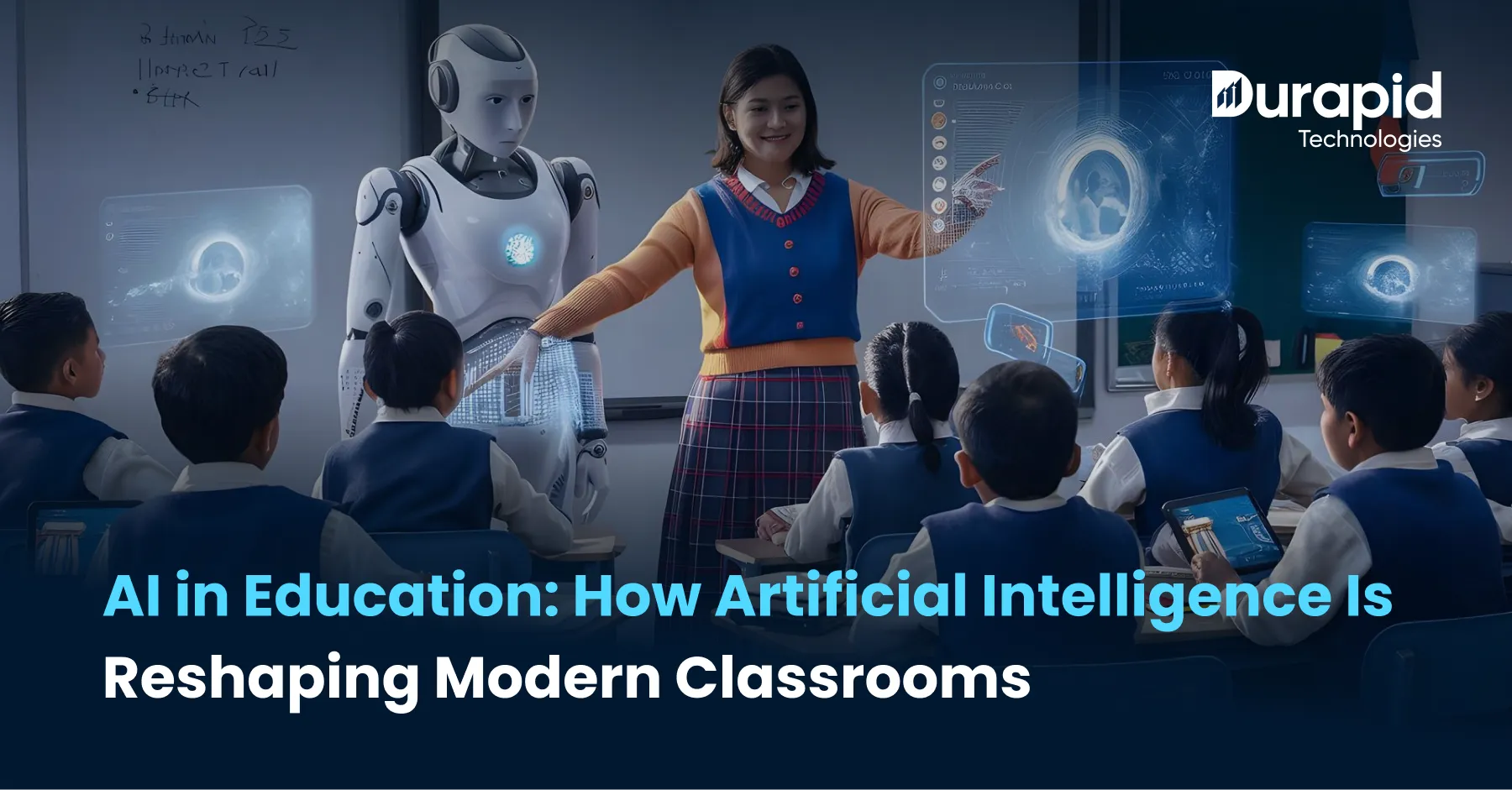
Imagine a scenario where a teacher in Ohio, who teaches Mathematics in ninth grade, enters her classroom filled with 32 students. Among them, five students are two levels behind in their studies, eight are working on advanced material, three have disabilities and need special teaching.
So how can a teacher handle this situation so different needs of the students are addressed?
The answer comes from the use of AI for education, powered by Gen AI Chatbot Development, intelligent systems that not only adapt content in real-time but also identify learning gaps immediately. In addition, they give teachers the insights that would take hours of manual analysis.
A 2024 McKinsey report claims that schools employing AI-powered adaptive learning platforms master concepts 34% faster. Furthermore, they show 28% improvement in standardized test scores as against schools using traditional methods. This isn’t the case of teachers being replaced rather it is a case of data-driven precision increasing their impact.
What Is AI in Education and Why It Matters Now
The term AI in education encompasses the use of machine learning, natural language processing, and predictive analytics. Schools set these up in learning management systems, assessment tools, and student support platforms.
Their functions include the analysis of learning behavior, automating the routine administrative activities, and on a large scale, delivering customized instruction. Obviously, the need is apparent. Traditional education is still utilizing the one-size-fits-all model from the industrial age. The current classrooms consist of students with extremely varied learning speeds, different styles, and even different backgrounds.
Non-instructional activities such as grading and attendance tracking consume up to 31% of teachers’ time. Meanwhile, 42% of the students say they are not interested in the lessons which are standardized. Clearly, AI for education can tackle these systemic inefficiencies with the help of automation and personalization.
The worldwide AI in education market got to $4.3 billion in 2024. It is likely to see an astounding 650% increase to $32.3 billion by 2030. Obviously, this is no surprise since leading educational institutes like Stanford, Georgia Tech, and Arizona State have already implemented voice-enabled AI teaching assistants.
These manage at least 40,000 student inquiries each semester while keeping the satisfaction rate at remarkable 94%. Moreover, K-12 schools that have embraced the AI-driven intelligent tutoring system not only reduce teacher burnout by 23%. Additionally, they improve the student engagement metrics by 38%.
How Education Systems Benefit From AI in Education
Educational institutions gain evident and quantifiable benefits from AI adoption. Specifically, the areas being administration, curriculum delivery, and student support infrastructure.
Automated Administrative Efficiency
The manual administrative processes in schools consume a lot of time and money. For instance, grading of exams and assignments takes up to 5–7 hours weekly for each teacher.
However, by using AI-based assessment tools, schools can reduce this to just 30 minutes. At the same time they provide more comprehensive analytics. Schools can do keeping track of attendance, optimizing schedules and allocating resources automatically. As a result, this eliminates the need for tedious manual work. Districts that have adopted AI in the administrative sector assert a reduction of operational costs by 47%. In addition, they speed up student record processing by 52%.
A certain school district in Michigan implemented automated enrollment processing. Consequently, it managed to free up 1,200 hours of administrative staff every year. They transformed $180,000 of the operational budget into instruction programs.
Predictive Analytics for At-Risk Student Identification
The traditional approach to education used the quarterly grading system to identify struggling students, this is often too late for the child to receive effective help.
In contrast, AI systems analyze all the student’s behavioral and performance indicators simultaneously in real-time. This includes assignment submission patterns, quiz performance trajectories, engagement metrics, and attendance trends. By the use of predictive analytics, schools detect students at-risk up to 6–8 weeks earlier than conventional methods.
As a result, the early intervention programs that rely on these insights increase graduation rates by 15–22%. Furthermore, they cut down dropout rates by 31%. The Los Angeles Unified School District’s AI prediction system tagged 8,700 students for intervention in the year 2023. Out of these, 67% got back to grade-level performance successfully.
Curriculum Optimization Through Learning Pattern Analysis
AI applications in education can analyze huge number of course completion records. As a result, this points out curriculum issues.
What concepts lead to the most student failures? Where do students spend too much time? What are the best teaching sequences to get the best results?
Arizona State University implements AI analytics to modify course structures. Consequently, the pass rates in traditionally hard subjects like calculus and organic chemistry have increased by 18%. Interestingly, the system figured out that students who did certain preparatory modules in the right order had 44% better final exam performance.
Benefits Of AI For Students
AI in education technologies that cater to personal needs, learning styles, and pace bring about radical changes to individual learners.
Personalized Learning Paths and Adaptive Content
In a traditional classroom, the teacher controls the pace. It is always the same for all the students no matter if some are ready to move on while others are not.
In contrast, the use of generative AI in education allows creating tailor-made learning paths for each student. If a student is quick to grasp the concepts of algebra, then the system moves him/her up to trigonometry. On the other hand, if a student has problems with solving quadratic equations, the system gives him/her more practice. Additionally, it offers different explanations.
Students benefiting from adaptive learning technologies make 26% quicker concept acquisition. Additionally, they have memory storage of 34% longer than those in conventional classes. The AI tutor from Khan Academy takes care of 2.1 million personalized learning sessions a day. Notably, students are getting 2.3x better in math proficiency after working with the tutor.
Permanent Learning Aid and Immediate Response Feedback
It is impossible for human teachers to be always available. However, AI tutoring systems provide instant help, regardless of the time or the place.
Students get instant feedback on their assignments instead of waiting for 48–72 hours for teacher review. Georgia Tech’s Jill Watson, an AI teaching assistant, responded to 10,000 student questions with a 97% accuracy rate.
Students figured out it wasn’t a human teacher only later. The response time was an average of 3 minutes, compared to 22 hours for human TAs. Overall, students who receive AI tutoring support experience a 41% decrease in time taken to complete homework. At the same time they achieve the same or even better learning outcomes.
Unprecedented Access for Special Education Needs
In the case of AI in special education, there are no access limitations for students with disabilities. For example, the application of natural language processing technologies enables speech recognition. It happens in real-time for the students with dysgraphia.
Automated reading machines using computer vision technology read textual content for the visually impaired students. Similarly, emotion detection technologies guide and enable interaction of students with autism in social scenarios. The children are in an environment that is not difficult for them. Schools using AI tools for accessibility report an increase of 56% in the performance of special education students. In addition, they report a decrease of 48% in the number of resources needed.
Microsoft’s Immersive Reader technology helps 23 million students with learning differences. It provides decoding, translation, and comprehension support in 110 languages.
Key Challenges and Implementation Barriers
Even though the benefits of ai in education have shown their value, schools still have to deal with quite a few challenges.
Specifically, they need to effectively implement these technologies considering the already existing infrastructure and the limited budgets they have.
Digital Divide and Equity Concerns
The use of AI in education demands constant and high-quality internet connection. Furthermore, it needs up-to-date computers or laptops.
Rural schools and urban districts with low funding usually do not have such infrastructures. Moreover, students without internet connection at home cannot take advantage of AI-assisted homework help or online tutoring services. The digital divide is a problem for 14.5 million K–12 students in the United States alone.
The schools that belong to the lowest income quartile have 3.2 times lesser number of devices per student. Their average internet speed is only 1/8th of wealthy district speed. Therefore, if districts do not fill the infrastructure gap, AI will only widen the existing divides in students’ learning. It won’t close them.
Teacher Training and Technology Adoption Resistance
Teachers who received training in the conventional way of doing things usually are not equipped with the necessary skills to handle an AI platform.
Unfortunately, the professional development programs do not help much either. Teachers voice that they are very new to the tools. 63% of them say that they get less than 5 hours of technology training per year in AI.
Schools should consider a total of 40–60 hours of initial training along with support throughout the process to define a successful implementation.
For example, in the case of schools that put in place developmental programs for every professional, the rate of adoption by teachers is 73%. This compares to 31% in districts that provide very little training. The annual cost per teacher can go up to $2,400–$3,800 which is a fairly large amount for institutions with limited budgets.
Data Privacy and Security Vulnerabilities

AI applications in education gather a huge amount of student data.
For instance, this includes patterns of learning, behavior information, academic performance, and personal demographics. This situation puts a great deal of strain on the privacy and compliance aspect of the law. FERPA, COPPA as well as the state laws are in place to protect this. The number of educational data breaches soared by 47% in 2023. Consequently, this resulted in the exposure of 3.2 million student records.
The AI systems which manage sensitive student information need strong security infrastructure. Districts subject them to regular audits. In addition, they have explicit data governance policies in place. Chatbot case studies show that unfortunately, a lot of school districts do not have cybersecurity professionals. They lack the funds needed to ensure proper protection.
Advantages of AI in Education
AI in education is a powerful tool that, if used properly, can provide measurable benefits. Specifically, not only in terms of educational outcomes but also in the efficiency of institutions.
Teachers are constantly engaged in grading, data entry, and paperwork for a total of 13 hours every week. However, the use of AI in this aspect automates the whole process. Schools reduce it to just 4 or 5 hours. This leaves one hour for instructional planning, student interaction, and professional development.
Notably, the grading done by the computer is so exact that it has a rate of 99.7% accuracy when handling objective assessments. These include multiple choice, fill-in-the-blank, and basic problem-solving.Students can now talk to an AI-powered chatbot. It will answer their basic questions about deadlines, course materials, and registration processes without the involvement of any human.
As a result, this means that teachers will deal with 60–70% less emails. Students will no longer have to wait 24–48 hours for their questions to be answered. Instead, they receive responses instantly. The number of districts using AI administrative tools have reported an annual cost-saving of $1,200–$1,800 per teacher as a result of efficiency gains.
For instance, a district with 500 teachers will save $600,000–$900,000 every year. They can use this for hiring more teachers or reducing class sizes.
Disadvantages of AI in Education
The balanced evaluation of AI in education requires observing the considerable limitations and risks of AI usage in class settings. Particularly, chiefly through the lens of the disadvantages of ai in education.
Loss of Human Connection and Social Development
The interaction and communication among people are the cornerstone of education.
Obviously, the teacher’s role is not only to convey information. Teachers also provide support, mentoring, and modeling of good character.AI systems, in their capacity of being non-human, cannot take over these duties.
Unfortunately, technology-dependent teaching methods might cut down on face-to-face meeting times. Thus, communication, empathy, and collaborative skill development would suffer. Schools achieve these all through interaction.Social-emotional competence evaluations show something interesting.
Specifically, students enrolled in heavily AI-integrated programs score 18% lower than their counterparts in schools. These schools maintain well-balanced technology usage.
Child experts in development point out that the constant interaction with screens in early childhood leads to inability to pay attention. In addition, they also note less physical activity. Lack of social skills are the main factors that are closely linked.
Algorithmic Bias and Fairness Issues
Artificial Intelligence relies on datasets that already carry biases to some degree. Therefore, AI systems inadvertently pick up these biases.
The error rate with which facial recognition systems identify students of color is three times higher than that of white students. This is an injustice created by biased training of algorithms.
Similarly, predictive algorithms derived from biased data in the school discipline department continue to operate in a discriminatory manner. Automated essay reviewing does not accept dialects of non-standard English. Furthermore, it shows a systematic bias against them.
According to the Stanford University report, AI-based proctoring systems accused Asian, Black, and Hispanic students of “suspicious behavior” at a frequency that was 23–31% greater than white students.
Specifically, not because of actual cheating but because developers based the algorithms primarily on data collected from one specific demographic group.
Concerns over Technology Dependence and Critical Thinking
The students who depend on AI tutoring systems a lot may become the ones who hardly ever solve problems without algorithmic help.
Obviously, the provision of instant answers by the AI may cause the students to skip the productive struggle. This is very necessary for the development of deep learning and critical thinking.According to research, students that used AI homework assistance scored 12% lower on the variations of the problems that were novel.
These are questions that required the transfer of learned concepts to new contexts.They performed well on the familiar problem types. However, the unavailability of algorithmic support made them struggle.
The Influence of Artificial Intelligence on Students’ Academic Development
AI in education creates a completely different environment regarding the way students learn, process information, and develop their cognitive skills. Specifically, this happens over time and in different subjects.
Better Learning Outcomes and Knowledge Retention
The meta-analysis of 47 studies reveals an important fact.
Specifically, students who receive AI-enhanced instruction will have a 0.42 standard deviation improvement in test scores.
This is equivalent to going from the 50th to the 66th percentile. This effect is strongest in STEM subjects. Specifically, AI provides interactivity through simulations and gives immediate feedback on students’ attempts to solve problems.
The math platform powered by AI from Carnegie Learning increases the students’ proficiency by 1.5 grade levels in just one school year. Furthermore, students taught through adaptive AI systems retain learned concepts 38% longer. This compares to traditional lecture-based instruction.
Early Career Preparation Through Skill Development
AI in higher education equally plays a part in making the current generation of college students ready for the future workplaces flooded with AI.
Specifically, they get the practical experience in the use of the tools that they will be professionals through. They develop skills of prompt engineering, algorithms literacy and collaborating with AI. The universities that provide AI-integrated curricula inform about their graduates getting starting salaries that are 27% higher.
In addition, they receive 34% more job offers from the fields closely related to technology.The students develop competitive advantages in the areas of data analysis, automation, and digital problem-solving.
Key Steps to Start Implementing AI Successfully
The schools that are going to adopt AI in education should abide by structured implementation frameworks. Specifically, these lead the way to novel ideas while still taking into account the practical constraints. And the needs of the stakeholders.
Conduct Comprehensive Needs Assessment
Specify the challenges that AI should tackle.
For instance, are you aiming to turn around the outcomes of the students who are struggling? Trying to lessen the workload of the teachers? Or provide better support in the area of special education? Different goals call for different solutions.
Ask the teachers, students, administrators, and parents to give their views on the issues. And the priorities. Evaluate existing infrastructure.
Determine the available internet speed, number of devices, and capacity for technical support. A school must have a minimum of 25 Mbps per 1,000 students for basic AI applications. And 100+ Mbps for advanced systems.
Therefore, set aside some money for infrastructure upgrades before buying any software.
Begin with Pilot Programs
Introduce limited pilots into 2–3 classrooms before the whole district takes it up.
Specifically, the tech-savvy and enthusiastic volunteer teachers will test the platforms. It will be a great opportunity for the school to keep collecting thorough data.
This includes student outcomes, teachers’ experiences, technical problems, and hurdles in the implementation process. Although they vary according to the different situations, successful pilots have a typical length of 8–12 weeks.
In addition, they use well-defined success metrics. Student engagement, learning outcomes, teacher satisfaction, and technical performance are the key areas to be measured.
Schools should use the data coming from pilots for the refinement of the next stages of implementation. This happens before scaling up.
Make a Commitment to Professional Development
Around 15–20% of the budget for AI patents will be earmarked for teacher training.
Specifically, teachers will have to receive 40 hours of initial training through the PPP. This covers platform functionality, pedagogical strategies, troubleshooting, and analyzing student data. Schools will also give them continuous support in the forms of peer mentors, help desk services, and regular professional learning community meetings.
Reports show that 68% of teachers in schools with good professional development programs adopt new technologies. In contrast, this compares to only 29% in schools with minimal training.
It is necessary for teachers to have time to play around with, fail, learn, and roll out AI tools into their day-to-day instructional practices.
AI’s Pros and Cons in Education: A Fair Look
One should see the complete picture of the pros and cons of ai in education.
Obviously, this helps stakeholders decide about adopting the technology in accordance with their preferred strategy.
| Advantages | Disadvantages |
| Personalized learning paths adapt to individual student pace and style | High upfront costs ($50–$200 per student annually) create budget barriers |
| 24/7 availability provides learning support outside classroom hours | Digital divide excludes students without reliable internet or devices |
| Predictive analytics identify at-risk students 6–8 weeks earlier | Algorithmic bias perpetuates discriminatory patterns in assessment |
| Administrative automation saves teachers 8+ hours weekly | Over-reliance reduces critical thinking and independent problem-solving |
| Accessibility tools support students with learning disabilities | Data privacy vulnerabilities expose sensitive student information |
| Real-time feedback accelerates learning and improves retention | Technology dependence may hinder social-emotional skill development |
This analysis indicates that you need to weigh the pros and cons of ai in workplace and education very carefully against each other.
Clearly, districts should adopt AI in a manner that is both thoughtful and practical. They should employ machine-led operation in office work and elementary skill development.
Meanwhile, allow for teacher-dominated critical thinking, creativity, social skills, and problem-solving that is complicated or drawn out. The best way to go about it is to marry AI’s capabilities with the human empathy and adaptive expertise of the teacher.
Therefore, get the best of both worlds.
Teaching Future of AI: New Trends
The upcoming AI use cases in education will be driven by very advanced features.
Specifically, these include emotional intelligence, multimodal learning, and cross-platform interoperability. The chatbot-like GPT tutors based on generative ai in education provide students with interactive conversational learning sessions.
Specifically, the student can ask in natural language and get personalized explanations instead of getting just one narrow response. The systems are smart enough to change the tone, complexity, and examples.
Specifically, they match the individual comprehension level of the student. AI and VR combined form a powerful duo, capable of creating breathtaking learning simulators.
For example, future doctors are going to practice their surgeries on AI-powered virtual patients. The students of the past will virtually transport to the events of the past through AI recreations.
The foreign language learners will speak to the AI avatars. Specifically, they will give them pronunciation feedback and cultural context in real-time.
Integrating blockchain with AI results in unhackable, movable and tamper-proof student instructional records. As a result, the credentials become valid at all educational institutions.
That cuts down on the fraud of transcripts and makes college admission quicker. The students will be the masters of their educational database. They will dictate who will have access to their learning history.
FAQs
How does AI make personalized learning in education better?
AI scrutinizes each student’s performance data. It modifies the content’s challenge level, speed, and teaching methods simultaneously. This offers unique learning experiences that cater to every learner’s needs and preferences.
What are the main benefits of ai in education for teachers?
Teachers can get rid of monotonous grading and paperwork. AI automates these hours. They gather data-driven insights on student learning and progress. They get help in managing the classroom through AI-powered differentiation tools.
Will artificial intelligence take over the teacher’s role in the classroom?
No, for sure.
Although, AI can perform at its best in delivering content, assessments, and doing admin work. It still lacks the capability to provide emotional support, mentoring, social-emotional learning.
And the creative judgment that makes a teacher effective.
What are the most significant obstacles for schools with AI implementation?
The main hindrance to AI being successfully implemented in education is simply the lack of modern infrastructure.
The gap between the digital haves and have-nots, inadequate teacher training, privacy issues with data.
And algorithmic bias.
In what ways does AI help children with special needs?
The application of AI in special education offers a variety of services.
These include text-to-speech, speech-to-text, personalized content modifications, emotional support based on recognition.
And learning interfaces that adapt to different learning difficulties and accessibility conditions.
How is AI transforming higher education institutions?
AI in higher education is revolutionizing university operations through predictive enrollment management, personalized degree pathways, automated administrative processes, and advanced research capabilities.
Universities leverage AI to analyze student success patterns, optimize course offerings, provide 24/7 virtual advising, and enhance the overall student experience while preparing graduates for AI-integrated workplaces.
What are the key disadvantages of ai in education that institutions should address?
The disadvantages of ai in education include reduced human interaction affecting social-emotional development, algorithmic bias perpetuating discrimination, over-dependence on technology hindering critical thinking skills, significant implementation costs, data privacy concerns, the digital divide excluding underserved students, and the potential loss of personalized teacher-student relationships that are crucial for holistic education.
How does the pros and cons of ai in workplace and education differ?
The pros and cons of ai in workplace and education share similarities but differ in application.
In education, AI focuses on personalized learning and student development with concerns about social-emotional growth. In workplaces, AI emphasizes productivity and efficiency with concerns about job displacement.
Both contexts benefit from automation and data analytics while facing challenges related to training, equity, bias, and the need to maintain human judgment in critical decisions.
Recent Blog

What Is Agentic Commerce? Strategy, Technology, and Implementation Guide
February 22, 2026