AI in E-Commerce: How Smarter Technologies Are Changing Online Commerce

AI in ecommerce is fundamentally changing the way retailers communicate with customers, handle their stock, and market their products through digital channels. Online merchants are already implementing smart systems that can detect and forecast buying patterns. They use ecommerce chatbots for customer support and even conduct personalized shopping on a massive scale. Adoption of these technologies results in the cutting down of operational costs. Meanwhile, conversion rates and customer delight increase. Movement away from automated systems based on rules towards intelligent and adaptable systems has marked a changeover in retail operations done digitally.
Today’s commerce platforms, powered by ai in ecommerce and Generative AI development services, are equipped with machine learning algorithms which can process an enormous number of data points within a second. Companies get the power of making quicker decisions regarding the area of pricing, product suggestions, and marketing activities. Businesses that step into these solutions are reaping huge benefits in terms of customer loyalty and sales increase.
What Is AI in E-Commerce?
AI in ecommerce is the use of machine learning, natural language processing, and predictive analytics to let the online retail operations be automated and optimized. The systems handle customer data, transaction history, and browsing behavior in order to give personalized experiences and operational efficiency as the main outcome.
The technology consists of a few primary parts that work together. First, there are machine learning systems that study the purchase history to anticipate future buying trends. Then, natural language processing is what turns chatbots and voice search into something usable. The next step is computer vision. It makes it possible for customers to search and recognize products visually. Finally, predictive analytics is the one that estimates demand and adjusts inventory accordingly.
A Salesforce report points out that 84% of customers believe that a company’s experience is as significant as its products. The retailers are no longer behind the curve. They are now rushing to deploy AI systems which are capable of recognizing individual likes and offering corresponding interactions through all channels.
Benefits of AI in E-Commerce
The use of AI in ecommerce can be seen as a multileveled improvement across numerous business functions, such as marketing, customer service, and even supply chain management. Companies see tangible enhancements of the key performance indicators after they apply AI-powered solutions.
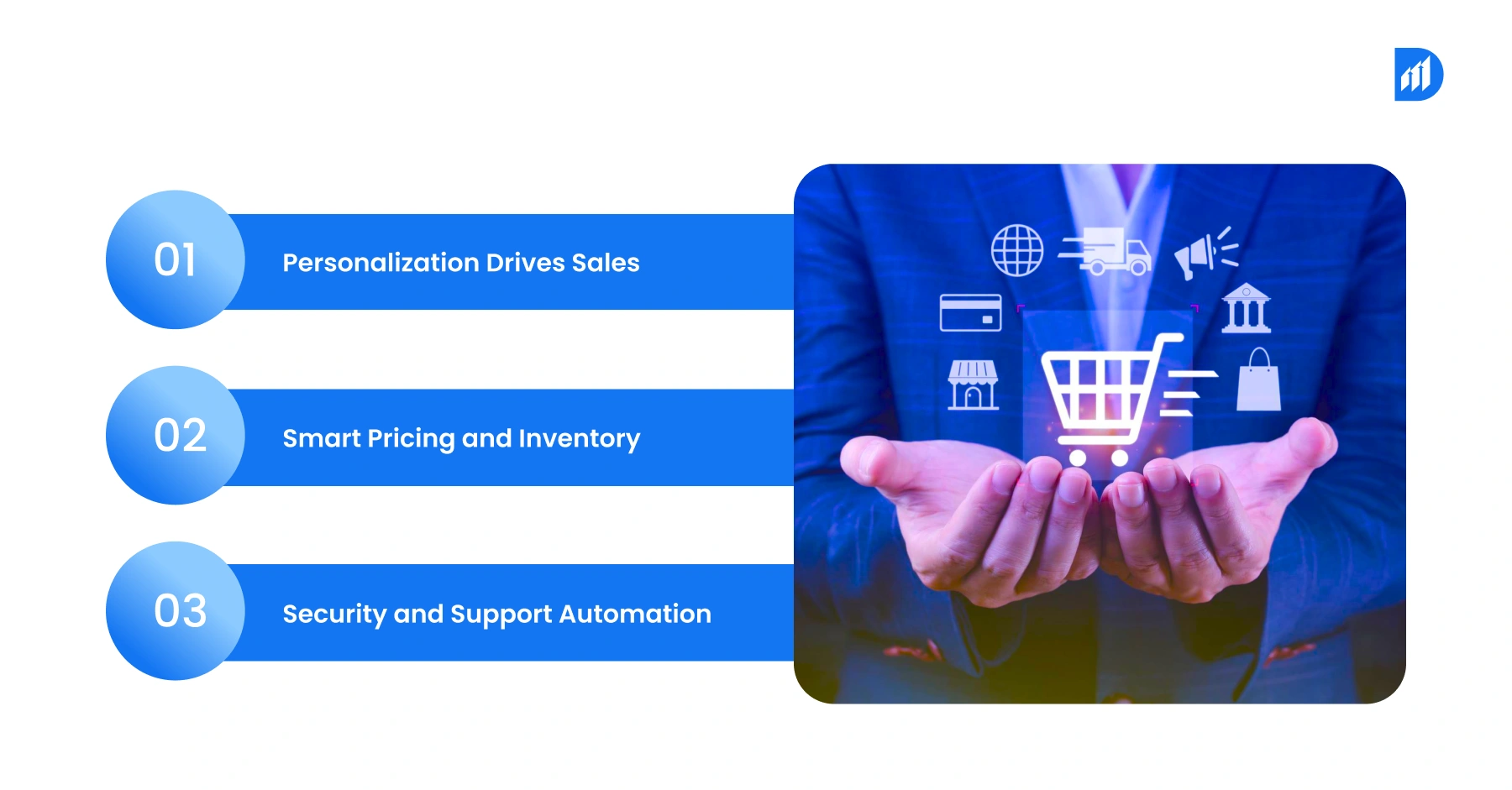
Personalization Drives Sales
Personalized product suggestions account for 35% of Amazon’s total revenue, which shows the huge effect of AI-based recommendations. The recommendation system monitors browsing habits and purchasing histories to display appropriate products at the ideal time. The average order value in sessions that interact with these suggestions is 369% greater compared to sessions that do not interact at all.
Philips noted a 3.74% rise in AOV and a 14% increase in conversion rates as a result of applying AI-based personalization on product pages. This is a trend that industry research has corroborated. Nearly all (98%) of online retailers state that average order values went up once they started displaying personalized recommendations on their website. The technology achieves this by identifying customer characteristics that are similar to those of other shoppers who bought related items.
Smart Pricing and Inventory
The technique of dynamic pricing used by the retailers involves automatic adjustment of product prices. It adjusts based on demand, what the competitors are charging, and the stock on hand. It is a common practice in the airline and hotel industries, where it has been in use for a long time. Now, retail platforms are also going the same way, applying the same logic to make the right balance between profits and pricing still being competitive.
By optimizing inventory, businesses minimize waste and avoid running out of stock. Among various techniques, predictive modeling is one of the most important when it comes to telling which items will be in demand and when. It does the forecasting based on seasonal patterns, promotions, and external factors such as weather or economic conditions. Companies strike the right balance of stock, while still having their money tied up in other areas rather than in an extra batch of products.
Security and Support Automation
Modern transaction monitoring systems can signal potentially fraudulent purchases in no time at all, just milliseconds. This is one of the practical uses of ai in ecommerce. These powerful algorithms analyze local purchase habits, device details, and people’s actions to inform possible fraudulent transactions. Companies reverse them before processing as part of their ECommerce Solution Services. The advantage of this is that the company saves a fortune on the cost of chargebacks. It also reduces the workload for the internal regulators.
Through the use of an AI chatbot for ecommerce, automation of customer support is handled around the clock. It consists of answering the most common inquiries. The questions about the order status, return policies, and product specifications that are frequently asked can be resolved by these systems without the involvement of a human. Customer service representatives can concentrate their efforts on complicated matters. They tackle the ones that demand emotional intelligence and problem-solving capabilities as they are the most difficult ones.
How Agentic Bots Are Redefining Online Commerce
The introduction of agentic AI in ecommerce shows a transition from the conventional customer-service chatbots to the extraordinary digital assistants. These manage customer transactions through their own initiative. These technologies go beyond merely responding to inquiries. They carry out transactions, arrange for deliveries, and even tackle problems with complete autonomy.
Traditional online store chatbots basically just follow pre-written scripts. If the customers have very difficult queries, then the chatbots will pass them over to the human agents. Agentic systems on the other hand can interpret very well the situation. They can recall the past interactions and can carry out the multi-step task without the help of a supervisor. They are even able to handle the returns, put the discount codes, and change the customer’s account information all while having a natural conversation.
How Agent E-Commerce Technology Works
The technology that supports the agents in the case of agent e commerce is based on large language models. Retailers train these on the retail-specific data. Such models comprehend product catalogs, company policies, and customer service protocols. They also take from the backend systems the stock to check, payments to process, and order statuses to update all at once and in real time.
The retailers who have adopted the agentic bots are enjoying cutting the cost of customer service by a great deal. The said systems process even 80% of the routine inquiries without the help of the staff. The time taken by the staff to respond to customers’ inquiries has been significantly cut down from a few minutes to just seconds. This leads to the improvement of customer satisfaction ratings. The bots are trained through interactions so that they become more accurate and helpful in the process.
During the time when one of the largest retailers was using the agentic systems for the post-purchase support, they reported an increase in online sales. Customers can change orders, delivery times, or ask for refunds through user-friendly chatbots. This made the purchase process less hassle and hence more enjoyable. This also resulted in higher customer retention. The group of consumers who made the last purchase were more likely to make the next one.
How to Implement Artificial Intelligence in E-Commerce Platforms
Integrating AI in ecommerce platforms is a process that requires careful planning. It ensures the technology and business objectives are in sync. Instead of using AI just because it is there, businesses should define particular issues that they are facing first.
Start with Data Quality Assessment
The first stage of the process is evaluating the existing systems and data to determine their quality. AI models need clean and organized data to produce precise results. Retailers should do customer database audits, transaction record audits, and product catalog audits. They make sure the data is accurate and harmonized. The use of low-quality data results in unreliable forecasts and faulty automation.
Then, companies should map out the use cases according to their impact and complexity for realization. The case of email personalization or product recommendations as quick wins is like a result made visible with moderate effort. More demanding applications like demand forecasting or dynamic pricing require thorough integration with existing systems.
Choose the Right Technology Stack
The choice of technology is determined by the company’s internal expertise and financial limitations. Major cloud services providers like Azure and AWS have premade AI services that shorten the development cycle. Most companies use these. Such services take care of infrastructure management and offer APIs for typical retail functions. Companies with unique needs may develop their own models with help from frameworks like TensorFlow or PyTorch.
The most significant technical obstacle is integration with current systems. AI applications must be linked to e-commerce systems, inventory management, and customer relations databases. APIs make connection possible, but retailers frequently need to use tailored middleware. They use it to connect older systems to new AI applications.
In the end, testing and validation make sure the models are performing as intended before deploying the entire system. A/B testing is a method in which people compare the AI-driven approaches with the existing ones. They find out the extent of improvement. Retailers need to begin with trial runs that are small in scale. These not only limit the risk but also demonstrate the value of the concept. Eventually, the whole platform can benefit from the successful trials.
Support in the form of training for the staff in using the new tools will not only help in eliminating the resistance. It will also lead to maximum adoption. The customer service teams will have to be trained in discerning when to rely on AI opinions. They learn when to take over the machine’s decisions. The marketing group will need to be well-versed in understanding AI’s insights. Then they can convert them into the right campaign strategies.
The Role of AI in Professional E-Commerce Operations
Generative AI in ecommerce is a technology that opens up new avenues for content creation and customer interaction. The advertising and marketing departments can directly benefit from these systems. They would be able to create product descriptions, marketing copy, and visual assets all at once. This mitigates the time and resources usually needed in case of manual content creation.
Content Creation at Scale
Product description generators take a look at item features and make unique, SEO-friendly text for every listing. This feature aids retailers with big catalogs in preserving the same quality over thousands of different products. People produce content that consists of corresponding keywords. It puts emphasis on the features that convert customers.
With visual search technology, customers locate items by sending pictures rather than typing in words. Computer vision models recognize the items, their colors, and styles in the pictures. Then they find the similar ones in the retailer’s stock. This tool is especially helpful for fashion and home decor retailers. The beauty of the product is the main factor that influences the buyers’ decisions.
Marketing and Customer Service Automation
The ecommerce marketing automation that uses AI optimizes the timings of campaigns, audience segmentation, and message personalization. The systems monitor the customers’ conduct to find out the most suitable times. They either send promotional emails or show targeted ads. This accuracy leads to higher engagement rates. At the same time, it cuts down the marketing costs.
The voice commerce integration enables the clients to buy using the smart speakers and voice assistants. The natural language understanding module deciphers the spoken words. It changes them into either product search or buy commands. This no-touch experience is popular with the time-starved people who like convenience.
AI customer service tools encompass more than basic chatbots. They involve sentiment analysis and predictive support, as well. By recognizing customer dissatisfaction in their texts, these systems escalate problems before people complain about them. On the other hand, predictive models are smart enough to spot customers likely to leave. They automatically start retention campaigns as their response.
In the ecommerce industry, the use of gen AI in ecommerce for supply chain optimization results in better logistics efficiency. Delivery planners utilize algorithms that take into account the shortest route. This leads to less delivery time and cost incurred on fuel. In addition, warehouse management systems are capable to anticipate which items will be in demand at certain places. This lessens shipping distances and quickens delivery.
How We Integrate AI Agents into Your Systems
Durapid Technologies provides Generative AI development services that not only bring intelligent automation. They also provide the ability to make data-driven decisions thus transforming commercial activities. To begin with, our proficient group will check your current setup. They find optimization areas, and install systems that provide you with measurable results.
Implementation starts off with customer journey mapping. The goal is to pinpoint areas where AI can make a difference. The consultants then proceed to dive deep into transaction data, support tickets, and user feedback. They bring out the most profitable implementations through their prioritization. The diagnostic stage is where people establish if the technology investments are in line with the business objectives or not.
The development process is very agile. It has several regular points where people do feedback and adjustments. We create a product with minimal features that show value quickly. Then we iterate based on the performance data and user feedback. This method lowers the risk. It allows for changes to be made before the entire deployment.
The support after the launch includes monitoring the model, optimizing its performance, and making it better all the time. AI systems are not very reliable if customer behavior changes rapidly and new data is not fed into them. Our team will be there to make sure your AI tools are always working at their best.
One of our AI App Development capabilities is the creation of mobile commerce applications. These are able to utilize device sensors, location information, and personalization engines. Thus, the applications offer contextual experiences. They adapt to the characters of the users in real time. The functionalities available are: augmented reality product visualization, voice shopping, and smart product finding among others.
Frequently Asked Questions
What is the major advantage of employing AI in e-commerce?
AI eliminates the need for employees and raises customer satisfaction levels. It does this via personalization and automation.
In which manner do ecommerce chatbots support customer service?
Ecommerce chatbots take care of regular inquiries right away. This minimizes wait times and allows human agents to deal with more complicated issues.
Will small businesses be able to bear the cost of AI implementation?
The cloud-based AI service providers have a pay-as-you-go pricing structure. This enables the smallest of companies to utilize the most advanced features.
How is it that AI is responsible for the revolution in ecommerce security?
AI systems observe and learn online fraud trends from transaction data and user behavior. They catch dishonest behaviour quicker than the traditional method of manual screening.
What kind of data do AI systems need to operate properly?
AI needs a clean record of transactions, customer profiles, product information, and behavior data. For making accurate predictions, the quality of data is of utmost importance rather than the quantity.
Recent Blog

Top AI Development Companies in India 2026
March 31, 2026