AI for Fraud Detection in Finance: Key Differences, Benefits, and Business Impact
Financial transactions occur at an astonishing rate of thousands worldwide every second. Banks complete payment approval processes while insurers handle claim processing tasks and lenders perform credit extension operations without requiring customer identification. Fraudsters exploit this hidden identities of users according to the statement. The implementation of AI for fraud detection has transformed the security system by using pattern detection which exceeds human capabilities to identify dangerous conduct.
The Association of Certified Fraud Examiners reports that global financial fraud losses reached 485.6 billion United States dollars in 2023. AI-powered fraud prevention in finance demonstrates its effectiveness by achieving 50 percent reduction in false positive results and 60 percent decrease in fraud-related losses when compared to organizations that use traditional rule-based systems.
What Is AI Fraud Detection for Finance?
AI for fraud detection refers to the use of machine learning, deep learning, and behavioral analytics to identify suspicious financial activity in real time. AI systems use machine learning to create models that learn from historical data for investigating fraud patterns instead of matching transactions to static rules. The core function of machine learning fraud detection uses algorithm training on multiple labeled transactions which include authentic and counterfeit transactions. The model establishes a risk assessment process which evaluates each incoming transaction based on multiple factors including transaction size, device fingerprint, spending velocity, and time of day. The system automatically detects and restricts transactions when their score exceeds a specified limit.
Current methods used for bank fraud detection combine unsupervised learning techniques with hidden fraud detection methods that identify abnormal data patterns without needing pre-existing fraud records. This effectively detects brand new types of fraudulent activities because it can analyze data that has never been included in training sets.
How AI Is Used in Financial Fraud Detection
The AI system for detecting fraudulent activities functions throughout all financial system parts. Fraud detection systems for payments use their models to process each payment transaction within 100 milliseconds which exceeds cart readers’ speed for completing their authorization process. The Decision Intelligence platform from Mastercard handles more than 75 billion transactions each year through its AI-based scoring system.
Artificial Intelligence systems in fraud detection in banking track how people use their accounts over extended periods. The system identifies an unusual spending pattern when a typical customer who spends $200 per week in one location tries to make a $4,000 wire transfer from a remote international location. This triggers a security check which requires the user to verify their identity through additional procedures.
AI and ML solutions also power fraud detection in auditing, where large datasets of financial records get scanned for anomalous journal entries, duplicate payments, or unusual approval chains. The process decreases manual auditing work by 70 percent while it makes the results more precise. Generative AI in fraud prevention creates an extra security measure through its ability to produce fake fraud situations which enable model training on upcoming attack patterns.
The main AI elements used to detect financial fraud include:
- Supervised learning models (XGBoost, Random Forest, Neural Networks) which use historical fraud labels to learn their detection methods
- Unsupervised anomaly detection (Autoencoders, Isolation Forest) for catching novel fraud patterns
- Graph analytics to trace account connections which enable fraud ring detection
- Natural Language Processing (NLP) for scanning transaction descriptions and flagging social engineering attempts
- Real-time scoring systems which use Apache Kafka or Azure Event Hubs to create decisions in less than one second
How AI-Powered Fraud Detection Differs from Traditional Methods
The method of fraud detection used in the past depended on fixed rules which researchers had to develop through manual programming. The rule required all transactions which exceeded $10,000 and originated from a new device to receive flagging treatment. The method becomes ineffective because criminals understand the limit which they must remain under to avoid detection. Rule-based systems require human input to develop new updates because they lack capacity for autonomous improvements. This leads to security vulnerabilities during periods when new fraudulent activities emerge before the system achieves detection capability.
The two methods demonstrate differences throughout four main evaluation areas:
| Dimension | Rule-Based Systems | AI-Powered Systems |
| Adaptability | Static, manual updates | Continuous self-learning |
| False Positive Rate | 15–20% of flagged transactions | 3–7% of flagged transactions |
| Detection Speed | Minutes to hours | Under 100 milliseconds |
| New Fraud Pattern Response | Weeks (manual rulewriting) | Hours (model retraining) |
| Coverage | Known fraud types only | Known + novel fraud patterns |
| Analyst Time Required | High | Low (exception-based review) |
The difference in false positive rate alone has a major business impact. A bank processing 500,000 daily transactions with a 15% false positive rate blocks 75,000 legitimate customers every day. The customer experience improves through a 3% rate which decreases to 15,000 and results in lower expenses for manual review work.
AI and ML solutions use network graph analysis to detect fraud rings which involve multiple accounts that seem to be separate but actually share common device IDs and IP addresses and behavioral patterns. Traditional rules cannot identify this particular type of organized fraud.
Use Cases for AI Fraud Detection in Banking and Finance

Credit Card and Payments Fraud Detection
AI assesses every card transaction by comparing it to an active real-time behavioral profile. The Advanced Authorization system which Visa developed utilizes artificial intelligence to evaluate more than 500 transaction data points. This results in a network-wide fraud reduction that saves $25 billion every year. The system identifies discrepancies between actual user conduct and anticipated user conduct based on specific merchant categories and customer locations.
AI-Powered Video KYC and Identity Fraud Prevention
The AI-Powered Video KYC Platform utilizes computer vision technology together with liveness detection methods to authenticate identity through real-time document processing and facial biometric analysis. The system protects against synthetic identity fraud which involves criminals using authentic and counterfeit data to produce fraudulent identities. According to McKinsey, this costs U.S. lenders more than $6 billion annually.
Loan, Insurance, and Audit Fraud Detection
Machine learning fraud detection models score loan applications against behavioral signals, device metadata, and third-party data sources. The system detects stacking fraud which involves applicants requesting multiple loans from different lenders. It also identifies income falsification through methods that standard verification processes cannot detect.
The Coalition Against Insurance Fraud reports that fraudulent claims cost insurers $308 billion annually. AI systems decrease claim investigation time by 40 percent while enhancing organized fraud scheme detection capabilities.
For fraud detection in auditing, AI tools scan general ledgers, expense reports, and purchase orders to find unexpected financial entries. The system identifies duplicate invoices and split-purchase schemes. It also detects cases where normal approval processes have been avoided. Auditors complete their work in hours instead of weeks.
Challenges of AI Fraud Detection in Finance
AI for fraud detection requires several elements to work correctly, and organizations must recognize these before building operational systems for actual use.
Data Quality and Labeling
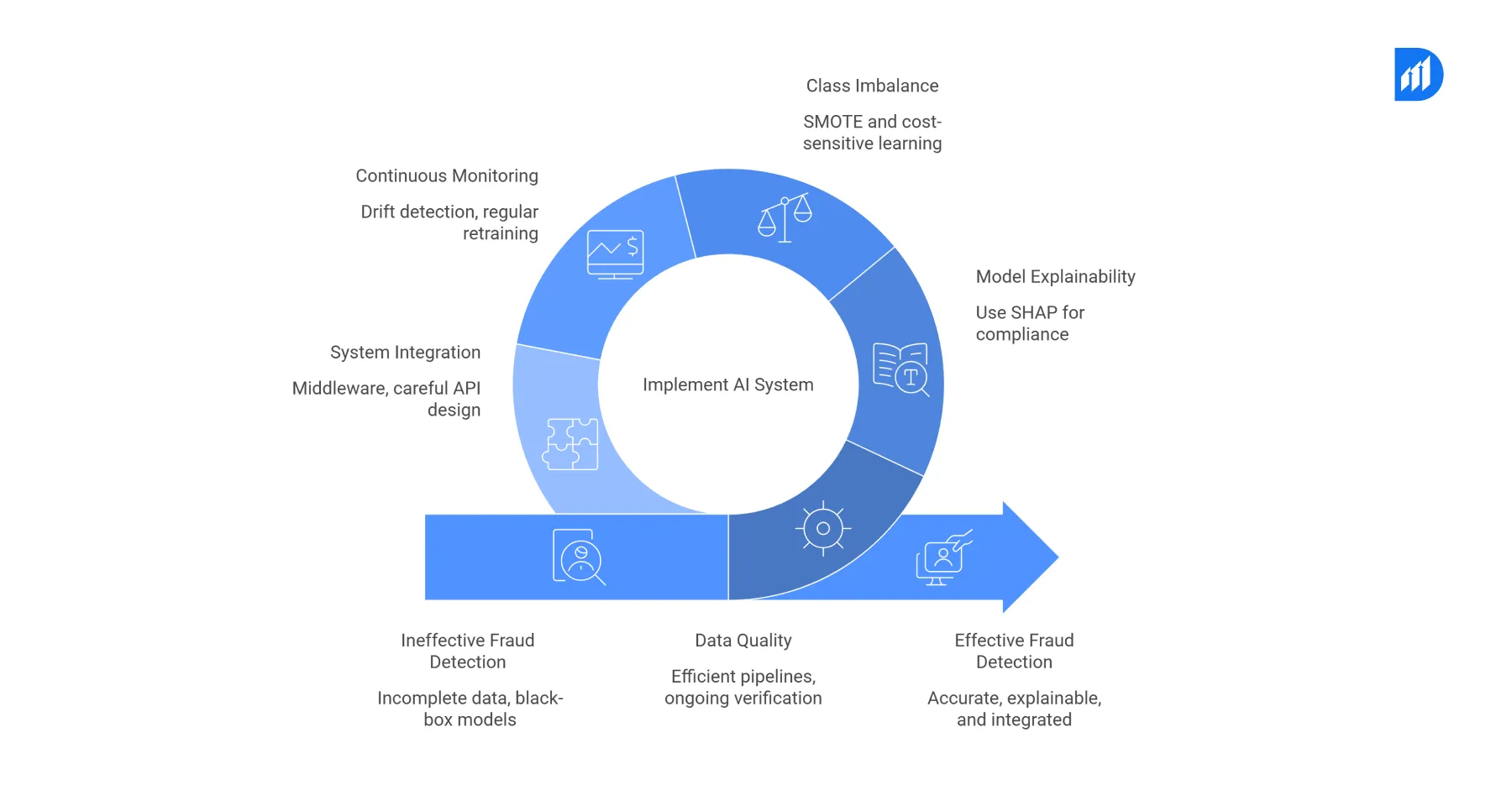
The training data for fraud detection contains incomplete fraud labels. The model does not learn from fraud detected three months after it occurred because the system does not update instantaneously. Financial institutions require efficient data pipelines and ongoing label verification to maintain model performance.
Model Explainability and Regulatory Compliance
Financial institutions must now provide explanations about their transaction flagging procedures and credit decision processes according to new regulatory requirements. Black-box deep learning models struggle here. Organizations need to find a middle ground between accuracy and interpretability, which they accomplish by using SHAP (SHapley Additive exPlanations) values to show compliance teams which features hold the most significance.
Class Imbalance and Adversarial Fraud
Fraudulent transactions typically represent less than 0.1% of all transactions. A model trained on imbalanced data will predict “legitimate” for all cases and still achieve 99.9% accuracy. The solution involves using SMOTE (Synthetic Minority Oversampling) and cost-sensitive learning methods, which demand careful execution.
Fraudsters study detection patterns and adapt. AI models that rely on historical data become outdated when fraud methods progress. Organizations must implement continuous monitoring together with model drift detection and regular retraining to maintain accuracy.
Integration with Legacy Core Banking Systems
Numerous banks operate their core systems through COBOL and legacy Oracle platforms. Connecting real-time AI scoring engines requires middleware architecture and careful API design while maintaining uninterrupted transaction operations. This is where implementation complexity most often derails AI for fraud detection projects.
How Durapid Technologies Simplifies AI Integration into Your Systems
Most financial institutions experience problems with AI implementation not because their technology fails, but because the path from a working model to a production deployment that scales, complies, and integrates cleanly is far more difficult than model training. The AI and ML Solutions from Durapid provide distinct advantages here.
Durapid develops complete AI fraud detection architectures designed specifically for financial institutions. The team creates real-time scoring systems which function on Azure Event Hubs or Apache Kafka and establishes secure REST APIs for core banking system integration. Explainability layers are built in to meet all regulatory standards. With 150 Microsoft-certified professionals and 95 Databricks-certified engineers, the team has successfully implemented fraud detection models which process millions of transactions each day without creating delays.
Durapid uses MLOps to manage fraud model lifecycles through automatic retraining triggers, model version control, new model A/B testing, and Power BI-based real-time drift monitoring. Your AI for fraud detection system will maintain its capabilities because of ongoing enhancements rather than gradual degradation.
Durapid also supports AI Marketing Agents and helps financial institutions develop enterprise-wide AI solutions which extend beyond fraud detection to customer intelligence and risk analytics. A fraud detection tool becomes a strategic advantage when it connects integrated AI systems throughout the entire organization.
Frequently Asked Questions
What’s the difference between rule-based and AI fraud detection?
Rule-based systems are like that strict teacher who follows the rulebook. If X happens → flag it. No questions asked. AI is more like the observant one in the room. It watches patterns. Learns behavior. Notices what’s actually unusual. Rules react to fixed conditions. AI adapts.
And because it adapts, it reduces false positives by up to 80% compared to static rules. Which basically means fewer “This transaction looks suspicious” texts at 2am.
How accurate is machine learning fraud detection?
Short answer? Very. Well-trained models can hit 95–99% precision on known fraud patterns. Long answer? Accuracy depends on:
- how clean your data is
- how often you retrain the model
- whether you’ve handled class imbalance properly
(Yes, fraud cases are rare. That’s the whole problem.) Good AI is powerful. Good data makes it reliable.
Can AI detect fraud in real time?
Yes. And that’s the impressive part. AI scoring engines built on streaming platforms like Apache Kafka can evaluate transactions in under 100 milliseconds. That’s faster than you blinking at your banking app. The system scores the transaction and makes a block/allow decision before the authorization process even completes. Which means prevention > damage control.
What types of fraud can AI detect in banking?
Pretty much the full spectrum. AI systems are used for:
- credit card fraud
- identity fraud
- account takeover
- loan stacking
- insurance fraud
- money laundering
- synthetic identity schemes
All within a unified detection framework. It’s not one model per problem anymore. It’s one intelligent system learning across patterns.
How does generative AI help in fraud prevention?
This is where it gets interesting. Generative AI creates synthetic fraud scenarios, fake but realistic attack patterns.The detection model trains on these before they even show up in the real world. So instead of reacting to fraud, you prepare for it. It’s like running fire drills for threats that haven’t happened yet. And in fraud prevention, being early is everything.

Rahul Jain
Recent Blog

Top AI Development Companies in India 2026
March 31, 2026