AI and ML: The Twin Technologies Reshaping How Businesses Operate and Compete
The implementation of AI and ML technologies has become essential for business organizations because these technological advancements now enable companies to make immediate operational changes. According to McKinsey’s 2024 State of AI report, enterprises that use both AI and ML together can make decisions 40 percent faster than their competitors. These competitors depend on traditional analytics methods. McKinsey states that these enterprises achieve 28 percent better profit margins through their dual technology approach.
More than half of business executives need help to explain the difference between artificial intelligence and machine learning. About 63 percent of them lack this ability. As a result, organizations spend an average of $3.7 million each year on projects that get canceled because of incorrect technology allocation. The confusion exists because people find it hard to understand two different technologies which both use data processing to create insights. Both technologies function at different levels because they process data to produce insights.
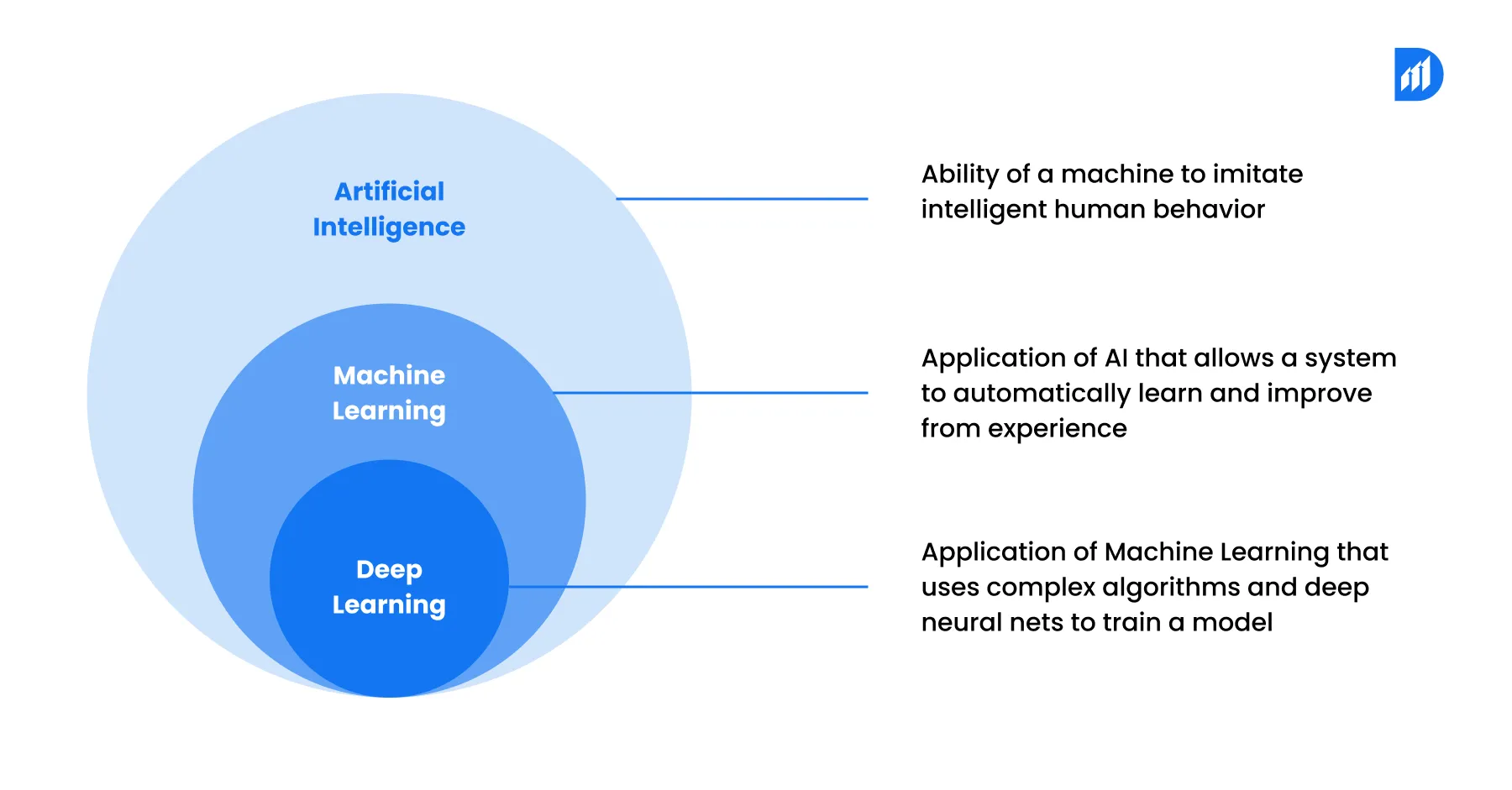
AI enables machines to execute tasks which require human intelligence through its complete system. ML functions as the mathematical framework which permits machines to acquire knowledge through data analysis. The distinction between these two technologies shows enterprises in digital transformation which system to use for customer interaction. The system needs to foresee the customer’s needs long before the customers themselves articulate them.
What Is AI and ML, and Why Do They Matter for Modern Businesses?
Two different sets of technology resources: AI and machine learning work in collaboration with one another to build “smart” solutions for business. Artificial intelligence enables computer systems to complete tasks which normally need human cognitive abilities. These include speech recognition and decision making and language translation and visual pattern detection. Machine learning functions as an AI component which allows systems to enhance their performance through practical experience instead of using predefined programming.
The business impact shows immediate measurable results. Companies implementing AI and ML solutions see operational cost reductions averaging 22% within 18 months of deployment. Customer engagement metrics show a 35% increase when personalized through ML algorithms. These changes create major organizational transformations which go beyond basic improvements.
The present business environment shows high importance because modern markets develop at speeds which human analysts cannot keep up with. Traditional business intelligence tools require analysts to construct reports while they need to discover trends and show their results. This takes them between several days to multiple weeks.
AI and ML systems process millions of transactions at high speeds. They find exceptions while predicting future results and suggesting measures before human teams detect any established pattern. Financial institutions that implement ML-based fraud detection achieve a 95% faster detection rate for suspicious transactions compared to rule-based systems. This helps them save $12 million in yearly losses for each institution.
The current system operates with data that has been gathered until the month of October in the year 2023. The technology stack powering these capabilities includes neural networks for pattern recognition. It also uses natural language processing for understanding human communication. Computer vision helps with analyzing visual data and reinforcement learning optimizes complex decisions.
The various elements of the system function to solve distinct business problems which range from automating customer service work to enhancing supply chain management efficiency.
What Is the Difference Between AI and ML in Enterprise Applications?
Enterprises show two different ways of using AI and ML which create the most clear distinction between these two technologies. AI powered chatbot systems function as the ultimate objective which aims to develop systems that display intelligent capabilities. Machine learning establishes the approach which enables systems to acquire intelligence through statistical methods that use data-based learning.
AI functions as the ultimate goal while machine learning serves as the main method for achieving that objective. AI customer service systems use automated technology to manage customer inquiries. These come through three different communication channels which include chat and voice and email.
The platform’s machine learning system examines dialogue patterns and customer feelings and solution results. This enhances its ability to produce accurate answers. After processing 100,000 customer interactions, an ML model achieves 87% accuracy in predicting customer intent. After 1 million interactions the model reaches 94 percent accuracy without requiring any changes to its codebase.
Gartner’s 2024 survey revealed that 68 percent of enterprises use AI solutions. Only 34 percent have built functioning ML systems that enhance model performance through continuous development.
Most AI systems show initial success which leads to their performance stagnation. AI systems without ML learning functions maintain their original performance but fail to adjust when business conditions change.
AI systems in enterprise applications function through user-facing features which include chatbots and recommendation engines and predictive analytics dashboards. ML systems operate in a hidden manner. They drive these features through algorithmic processing of training data. This enables pattern recognition and parameter modification for prediction results.
Retail pricing AI establishes the best prices for products in the store. It uses machine learning models which examine historical sales data and competitor pricing information and inventory amounts and seasonal patterns. The system analyzes customer buying habits to produce its pricing suggestions.
Technical Architecture Differences
The technical architecture shows major differences between two systems. Both systems require different infrastructure elements for their AI and ML implementations, including use cases such as Generative AI in Healthcare.
AI systems require strong application programming interfaces together with user interface components. They need system integration frameworks to connect with organizational operations. ML systems require organizations to provide them with advanced computing equipment and large capacity data storage. They also need high efficiency data processing systems. MLOps platforms handle model development and training and deployment activities.
Organizations that implement both technologies distribute their financial resources carefully. They spend 40% of their budget on data infrastructure while reserving 35% for model development. About 25% goes to system integration and deployment.
What Core AI/ML Technologies and Capabilities Do Intelligent Business Systems Use for Their Operations?
AI and ML technologies include multiple dedicated systems which address specific business problems. Enterprises will choose the proper technology for their business operations after they understand the main system capabilities.
Neural Networks and Deep Learning
Most current machine learning systems depend on neural networks which function like the brain structure of humans. They can recognize intricate patterns. Deep learning uses multiple processing layers to build upon basic neural networks. This allows machines to develop increasingly sophisticated concepts from their initial data input.
Convolutional neural networks achieve their highest performance in image recognition. They reach 99.7% accuracy during medical imaging diagnosis tests. This exceeds human radiologist results in particular cancer detection tests. Recurrent neural networks work well for both time-series forecasting and natural language processing applications. They can process sequential data.
Natural language processing enables machines to understand human language through its three functions of comprehension interpretation and language production. Enterprise NLP applications process customer feedback and analyze contract terms. They extract insights from unstructured documents and power conversational AI interfaces.
Organizations implementing NLP for document processing reduce manual review time by 78%. They process contracts that previously took 40 hours in just 8.8 hours.
Computer vision allows machines to interpret visual information from cameras medical imaging devices satellite feeds and quality control sensors. Manufacturing facilities using computer vision for defect detection identify product flaws with 96% accuracy. This compares to 84% accuracy from human inspectors.
Advanced ML Techniques
Your training data extends until the month of October in 2023. This technology examines multiple routing options to find the best routing solution which works best for different situations.
AI ML technologies include transfer learning which enables researchers to use existing machine learning models. These have already been trained on extensive datasets. Researchers can build new systems with specialized functions that need only minor additional data training. Enterprises that lack sufficient labeled data for their projects depend on transfer learning to create successful AI systems. They need only 10 percent of the standard training materials. Domain-specific results arrive within six weeks instead of eight months.
Edge AI delivers machine learning abilities to devices which analyze information at their location. It avoids transmitting data to remote cloud storage systems. Edge AI manufacturing sensors detect equipment failures 200 milliseconds before actual breakdowns. This allows manufacturers to stop production line downtime that costs them $260000 every hour.
Customer Experience Applications
Deep learning models power customer experience applications. They enable businesses to create customized interactions with their customers through their entire service delivery process. E-commerce platforms use machine learning recommendation engines which drive 35 percent of their total revenue.
Generative AI technology changes how people create content and generate code and design products. Marketing teams using generative AI produce 10x more content variations for A/B testing. Software developers using AI coding assistants write functional code 55% faster with 40% fewer bugs.
Financial Services Applications
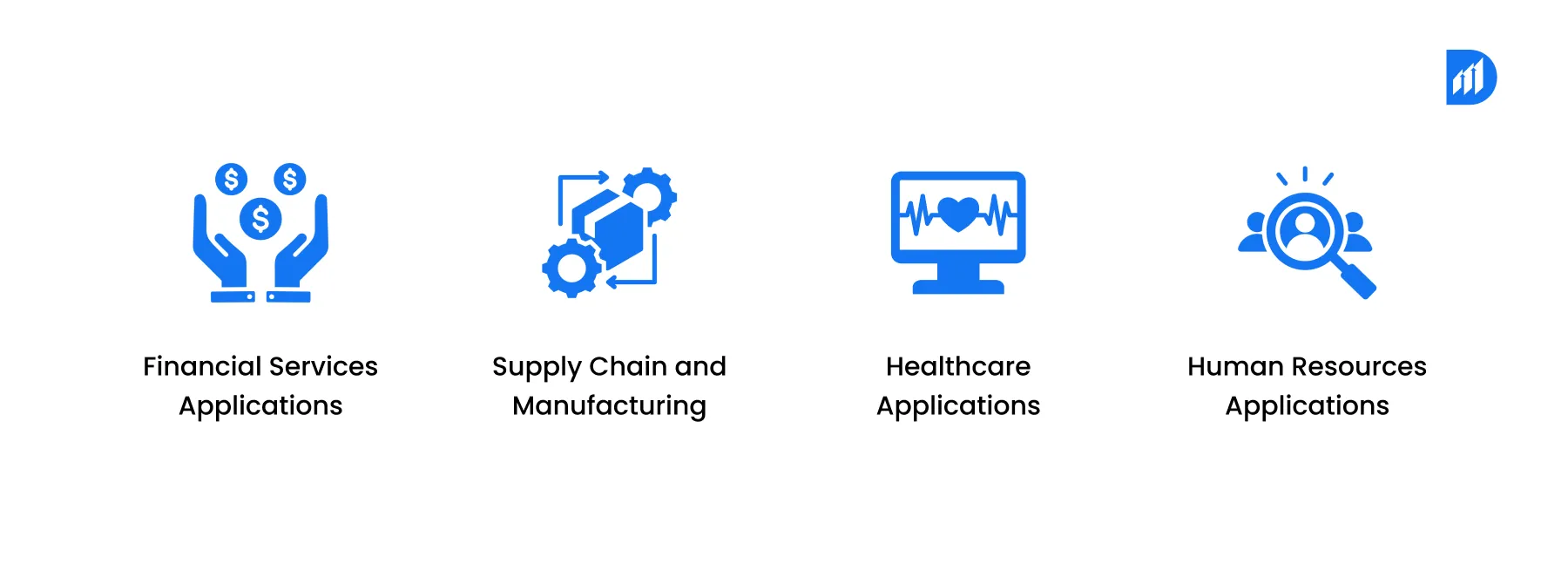
Financial services use AI and machine learning for their fraud detection systems and credit risk assessment tools and algorithmic trading operations. Banks using ML fraud detection systems block fraudulent transactions with 94% accuracy. They reduce false positives by 50% minimizing customer friction from declined legitimate transactions.
Supply Chain and Manufacturing
AI ML technology develops its highest-impact applications through supply chain optimization. Predictive maintenance models analyze sensor data from manufacturing equipment. They predict failures 5–7 days before they occur with 92% accuracy.
Healthcare Applications
Deep learning technology has multiple healthcare applications. These include diagnostic imaging and drug discovery and personalized treatment planning. Medical image analysis AI systems identify lung cancer with 94.4% accuracy while human radiologists achieve 91.8% accuracy.
Human Resources Applications
AI and ML systems become essential tools for human resources departments. They help organizations find suitable candidates and predict employee turnover and evaluate required competencies. Recruiting platforms which use machine learning to screen resumes achieve a processing speed which is 75 times faster than human assessment.
Frequently Asked Questions
What is the distinction between AI and ML?
The distinction between AI and ML exists because AI describes the complete range of intelligent machine operations while ML delivers a particular method which enables machines to acquire knowledge from data without requiring specific programming for every situation.
How long does implementation usually take?
Basic systems need 6 to 8 weeks for their initial tests. The time required for enterprise solutions achieves three to six months which depends on the existing data and the difficulties of system integration.
What kind of operational impact can enterprises expect?
Enterprises achieve 15 to 25 percent operational cost reductions together with 20 to 35 percent efficiency improvements which they accomplish during the first 18 months after implementation.
Do organizations require specialized AI/ML engineers?
The answer to this question depends on whether we require specialized AI/ML engineers in our organization. The project needs data scientists ML engineers data engineers and domain specialists to complete their work successfully. The project team will experience a 60 percent increase in project failure rates because they do not have all the necessary team members.
How are AI systems protected from adversarial attacks?
Adversarial attacks on AI systems receive protection through a system that uses adversarial training and input validation before model ensemble execution while it continuously checks for unusual prediction patterns.

Deepesh Jain
Recent Blog

How Much Does AI Development Cost in 2026? A Complete Guide
March 23, 2026